


I planned a different post for today, but I feel I have to say something about the elephant in the room.
Two years ago, when I came to Substack I was frustrated about Medium’s AI policing (yes, not just policy). It’s not that they were against AI slop, that’s fine. It’s that they said they don’t allow AI writing but they didn’t have clear rules on how to determine whether the writing is AI or not. They still don’t.
Fast forward till today.
I never thought I’d come to a moment when I’d wonder if Substack is becoming Medium (in the bad way). Today I did.
When I read this post, I immediately got one of these “oh no” moments.
When I came to Substack I felt relief. Finally there was a place without stupid rules no one follows, AND with the highest level of quality I have ever seen online. I was convinced the platform, probably because of the paid memberships, had found a way to self-regulate quality.
I believed it served like a glue for a community that doesn’t exist elsewhere - with genuine connections, with real conversations and with human connection.
But not anymore…
What happened?
Substack just gave every reader a scan button for AI writing. In partnership with Pangram.
The reactions? Writers panicking in DMs. Writers posting their opinions. Writers announcing they’ll quit before a robot gets to accuse them of anything.
Lots of emotions. I saw the exact same polarity I saw on Medium before I decided to leave and join Substack.
That was my “oh no” moment.
So tell me…
I did what I always do.
I tested it.
I ran my latest post (which I wrote using my AI minions) through the detector. It said it’s 100% human.
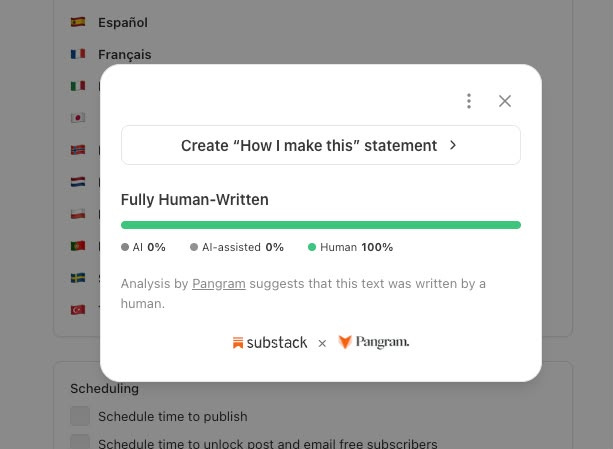
Look. I used AI on that post.
And I’ll get to it, but first, let’s take the temperature down, because most of the panic I’m seeing comes from people who haven’t read what actually launched.
What Substack actually launched
On July 21, Substack CEO Chris Best published “Against Claudefishing” and announced the Pangram integration inside Substack.
“Claudefishing” is his word for the deception when you think you’re getting a human connection but there’s no one on the other end.
So readers can now scan posts, notes, replies, and comments to see an estimate of how much of the text was written by AI.
That’s the headline.
Now the small print, because the small print is where the blood pressure drops:
It only works on text published from July 21 onwards. Nobody can scan your archive. Your old posts are untouchable.
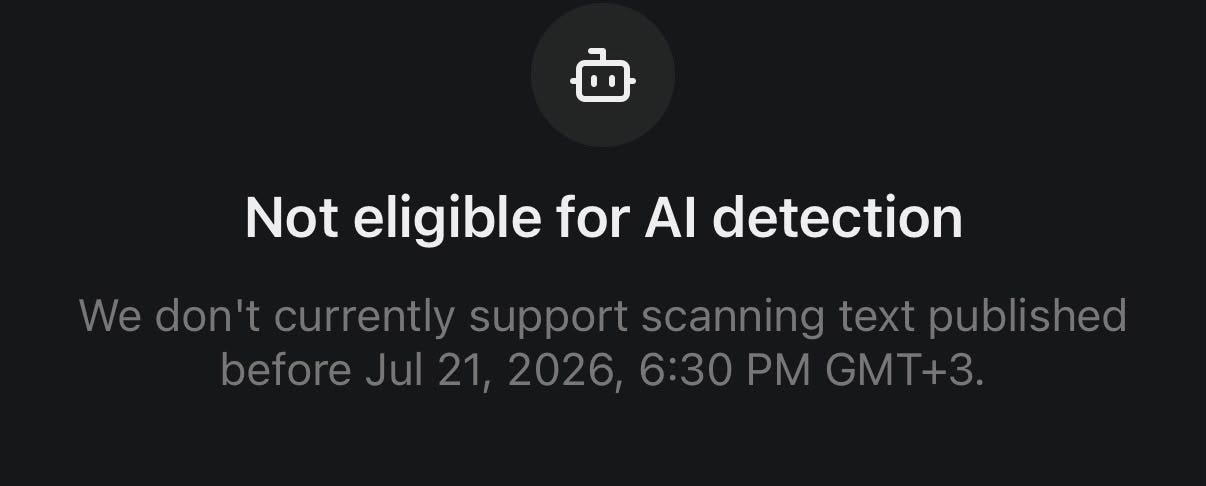
Also, it only works on text longer than 100 words. Phew, my Notes are safe 😏
Also, only the reader who requests a scan sees the result. There’s no public AI badge slapped on your post.
Also, paid posts can only be scanned by paid subscribers. I tested this myself: even when the paywall sits at the very bottom and nothing is hidden behind it, free readers are not able to scan.
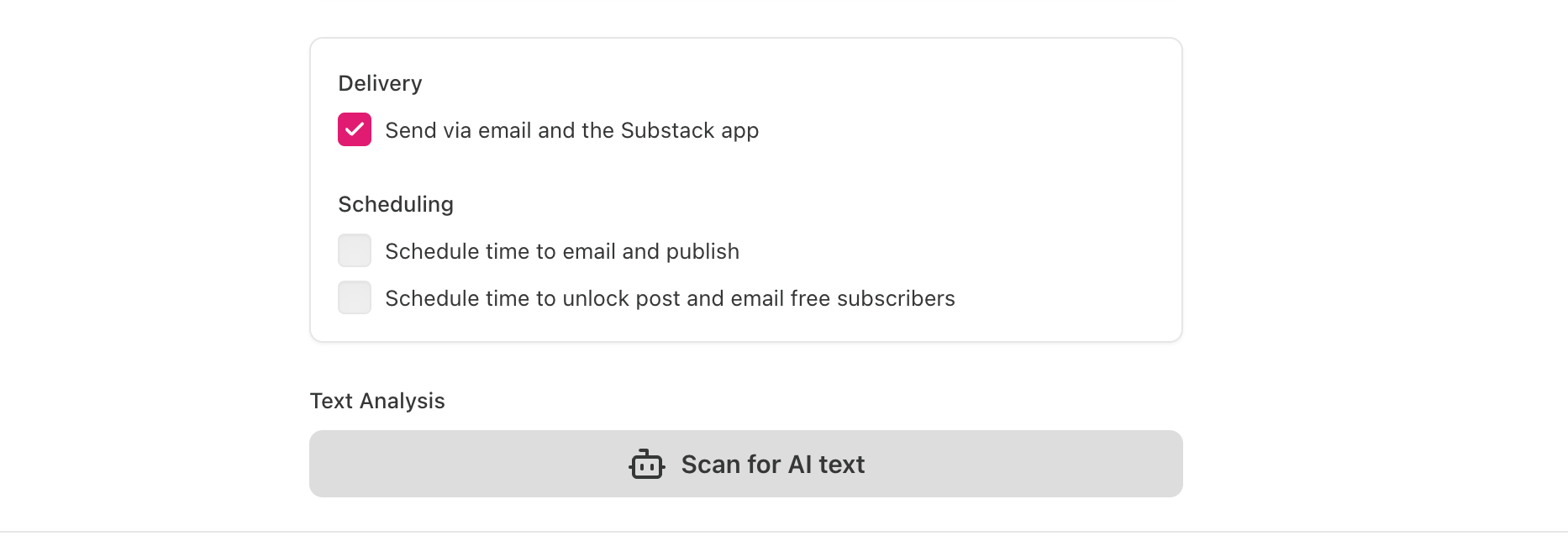
Also, you can run it for each of your posts before publishing so you know what you’re putting out there. It’s at the bottom of the screen before you hit publish:
Also, you can switch it off. Not a global setting, you have to do it per post, from the very same place, and it only appears after you scan your own post - you have to click the three dots:
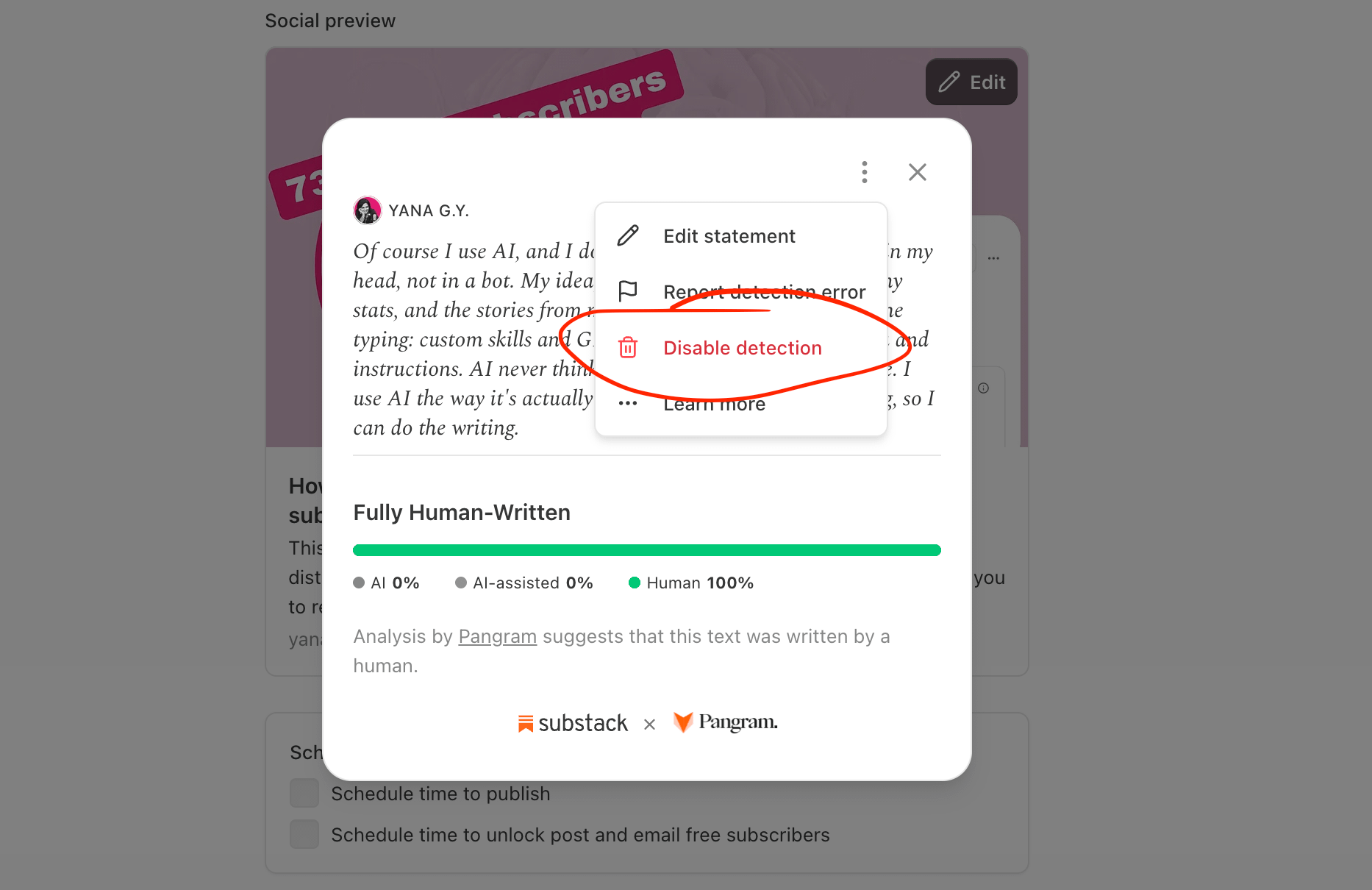
The worst place ever, I know. But it is what it is.
Edit: today - one day after I published this post, the placement of this setting changed so now it’s more visible and you don’t have to scan first:
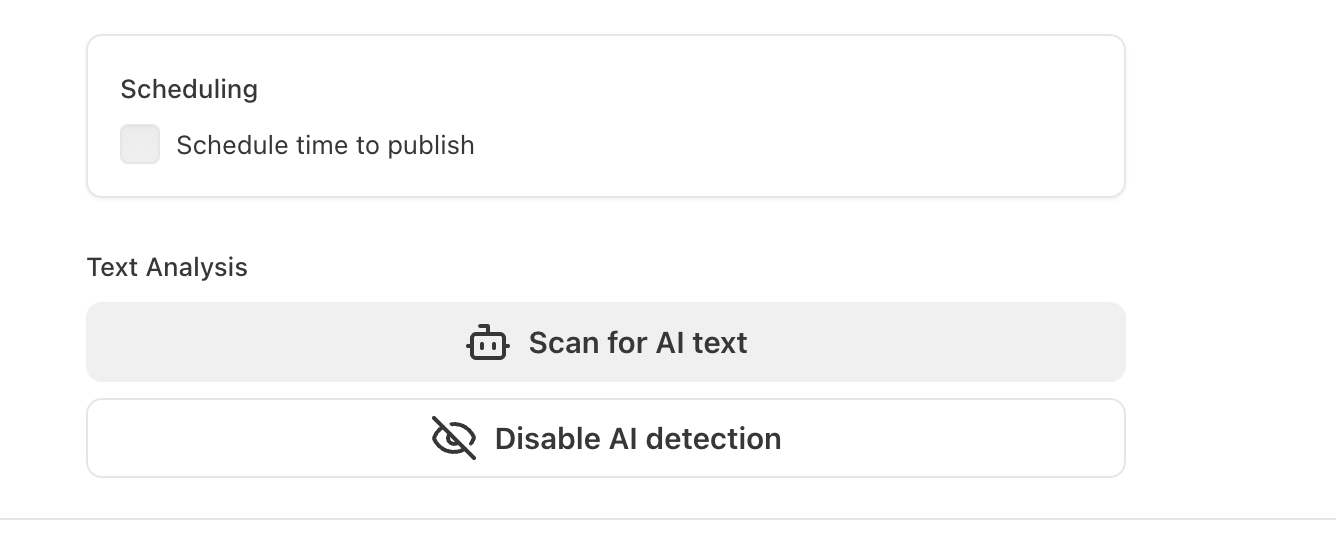
Also, we got a new tool: a “How I make this” statement - your own words about your process, shown to anyone who checks your content.
So what Substack did is way better than what Medium tried to do.
We have a real tool, not some vague rules.
We also have the choice to use it or not.
And the freedom to state what we actually do.
I honestly believe that if not all, at least our paid members deserve to know what do they pay for.
So I’m cool with it.
And here my AI minion wanted to say that the actual damage is none, but I don’t feel like it.
The damage is HUGE, and it’s in the polarized community.
The emotions are running about 10 times bigger than the feature.
And for a good reason.
Because think about it: it’s not always black and white.
Non-native speakers use AI all the time, and it’s not always “slop” (Daniel said this out loud in this post).
And what about new writers who didn’t find their true voice yet - they don’t use AI, but their writing is inevitably blending with the slop, so they get miscategorized as AI.
Not to mention authors. I’ve talked to I don’t know how many best-selling writers (some pretty famous) whose writing was flagged as AI-generated just because AI was trained on their work.
How does Pangram work?
I also found that there’s a new Substack publication called Pangram, and they tried to bring in some clarity in this post.
My read?
It is a classifier, a neural network that reads a piece of text and asks one question: who does this sound like?
The main difference (and why they say they’re the best) is that they don’t try to guess how LLMs work, but they actually train it with real human and AI written texts.
Their dataset of known human text stops at 2021, before AI flooded the internet. For every human text in it, they generate an AI “double” - same length, same tone, same topic, machine-made. The model trains on those pairs until it can tell them apart.
And it needs a minimum word count, because more words mean a more precise spot on the map. That’s why the 100-word rule is there.
This approach is smarter than the old detectors, the ones that flagged the Declaration of Independence as AI-generated. Credit where due.
Can you trust the verdict?
Not fully, no.
Ruben Hassid, who writes about AI to 800,000+ readers, spent 3 hours and $34 of Claude Code credits trying to beat Pangram. He built a dedicated skill just to bypass it. Mostly, he lost. Pangram caught rewrite after rewrite.
Then he swapped a single character in the text.
100% human.
One edit. That’s the distance between “AI generated, confidence high” and “fully human-written.”
Here’s his post and his free skill if you want to test it.
As for me?
I make data-driven decisions and my data says: treat any scan as an estimate, never as proof.
Which brings me back to my 100% human score.
Why my AI-assisted post scans 100% human
Because the post is mine.
Because of course I use AI and I don’t hide it.
But I use AI in (what I believe to be) the right way.
Every post starts in my head, not in a bot.
It’s ALL my idea, my strategy, my numbers from my stats, and the stories from my life.
Then my AI minions do the typing: custom skills and GPTs loaded with years of my data and instructions. I now give them to my paid members, and for my coaching clients I create personalized versions.
AI never thinks, decides, or has opinions for me. I use AI the way it’s actually made to be used: to do the typing, so I can do the writing.
That’s how I built a 6-figure business on the side of my 9-5 job now making $20k a month. That’s also why many others who use AI the wrong way couldn’t do it. Even when many of them tried to reverse-engineer what I do.
They never will.
AI is leverage. Anyone who doesn’t use it will eventually be outrun by their competitor who’s faster, cheaper, easier to use.
There’s a lot of proof in the past for businesses who rejected new technology and failed. History repeats itself for those who are blind to see it.
“We didn’t do anything wrong, but somehow we lost” said Nokia CEO on the announcement of the acquisition by Microsoft.
And that’s the exact problem: they didn’t do anything. At all.
So yes, I believe EVERYONE should use AI. The right way.
Used lazily, AI speaks instead of you, and readers feel it in 2 words.
Used properly, it gets you ahead in the game faster.
And Substack knows the difference. Chris Best wrote it in the announcement: they use AI at Substack all the time, for software, research, and product features. Substack is fighting slop, not the use of AI. Two different problems.
Slop is content nobody wrote, for nobody. Fire away at it, I say.
I use AI a lot but I don’t produce slop.
Which is why I’m adding my “How I make this” note today. Anyone who checks my content will read my view of it, in my words:
Of course I use AI, and I don’t hide it. But every post starts in my head, not in a bot. My idea, my strategy, my numbers from my stats, and the stories from my life. Then my AI minions do the typing: custom skills and GPTs loaded with years of my data and instructions. AI never thinks, decides, or has opinions for me. I use AI in (what I believe to be) the right way to use it: to do the typing, so I can do the writing.
Steal the format if you like.
What else will I do now?
Two things.
First: the next QUEST LABs video is exactly about this and it perfectly aligns with the timing. I announced it months ago and now I’m ready with it (finally, phew).
It’s about how to make AI write like you - my most complex AI protocol for ChatGPT and Claude, finally revealed, start to finish. Stay tuned, I’ll probably publish it tomorrow.
Second, and this one is for today: I’m giving you my personal writing rules skill for Claude.
It’s the rulebook all my minions load before writing a single word for me. The anti-AI rules: banned words, banned patterns, the full list. Plus my signature style, the moves that make you know it’s me by line 2.
But please use it with caution. One of me is enough. Personalize it before you run it. It’s also not perfect - sometimes it will feel not like me, because it’s AI, models change all the time, it can’t NEVER be 100% like me.
I always edit.
But my protocol allows to publish high quality content faster.
Brings my work at levels impossible to reach without AI.
So use it with caution.
As of today, the same rules are now into the CREATIVETECH Writer PRO, my custom GPT that writes like me.
Both live in my Gumroad, and they’re 100% free for paid members, as usual. The only thing behind the paywall below is the 100% off discount code. Nothing else.
Upgrade to get access to this priceless Claude skill, as well as all of my other AI minions for free and so much more in the QUEST:
Quick Q&A my AI minions wrote for me
Can readers scan my old Substack posts for AI? No. The scan works only on text published from July 21, 2026 onwards, and only on text longer than 100 words. Your archive stays untouched.
Can free subscribers scan a paid post? No. I tested this: even when the paywall sits at the bottom and hides nothing, only paid subscribers get the scan option.
Can I turn the AI scan off on my posts? Yes, per post. Scan your own post with Pangram first, then the switch appears at the bottom of that post’s settings.
Is the Substack AI detector accurate? It’s the best detector out there and still beatable. Ruben Hassid flipped a verdict from 100% AI to 100% human by changing a single character. Treat every scan as an estimate, not proof.
Does using AI mean my post scans as AI-generated? No. My AI-assisted post scanned 100% human, because the ideas, the data, and the final writing are mine. The verdict follows the workflow, and lazy prompting is what gets caught.
Yana
P.S. By the way, this post also scanned 100% human and guess how I wrote it 😎 I left the Q&A part untouched intentionally and it still says 100% human. I create personalized versions of my AI minions for my VIP members and coaching clients, so let me know if you want one.
I knew you would have an opinion on this or if anything facts and I greatly appreciate the way you presented everything. To me it’s not even about it the writing it’s about the way people judge something based on something that isn’t accurate. Everyone utilizes tools and I just think this could damage so many people unnecessarily. Truly believe we don’t need more reasons to be divided, if you read something and it spoke to you why does it matter what the scan says?
The problem is the witch hunts of posts written 100% by humans without AI that inaccurately get flagged as AI assisted.
Because those that are AI savvy understand the small AI tells... which... gasp in horror... are actually trained from writerd and are normally good writing.
So many people who dont use AI are being flagged as AI.
Which is going to cause a huge and damaging witch hunt.