


“Don’t polish your writing, say what you really think, even if you get some haters. That’s how people remember you.”
That’s a Substack Note I posted on May 5. Just twenty-five words. No link. No CTA. No sales pitch. I almost didn’t publish it. The wording sounded too aggressive in my head. I sat with it for a minute, then hit post anyway.
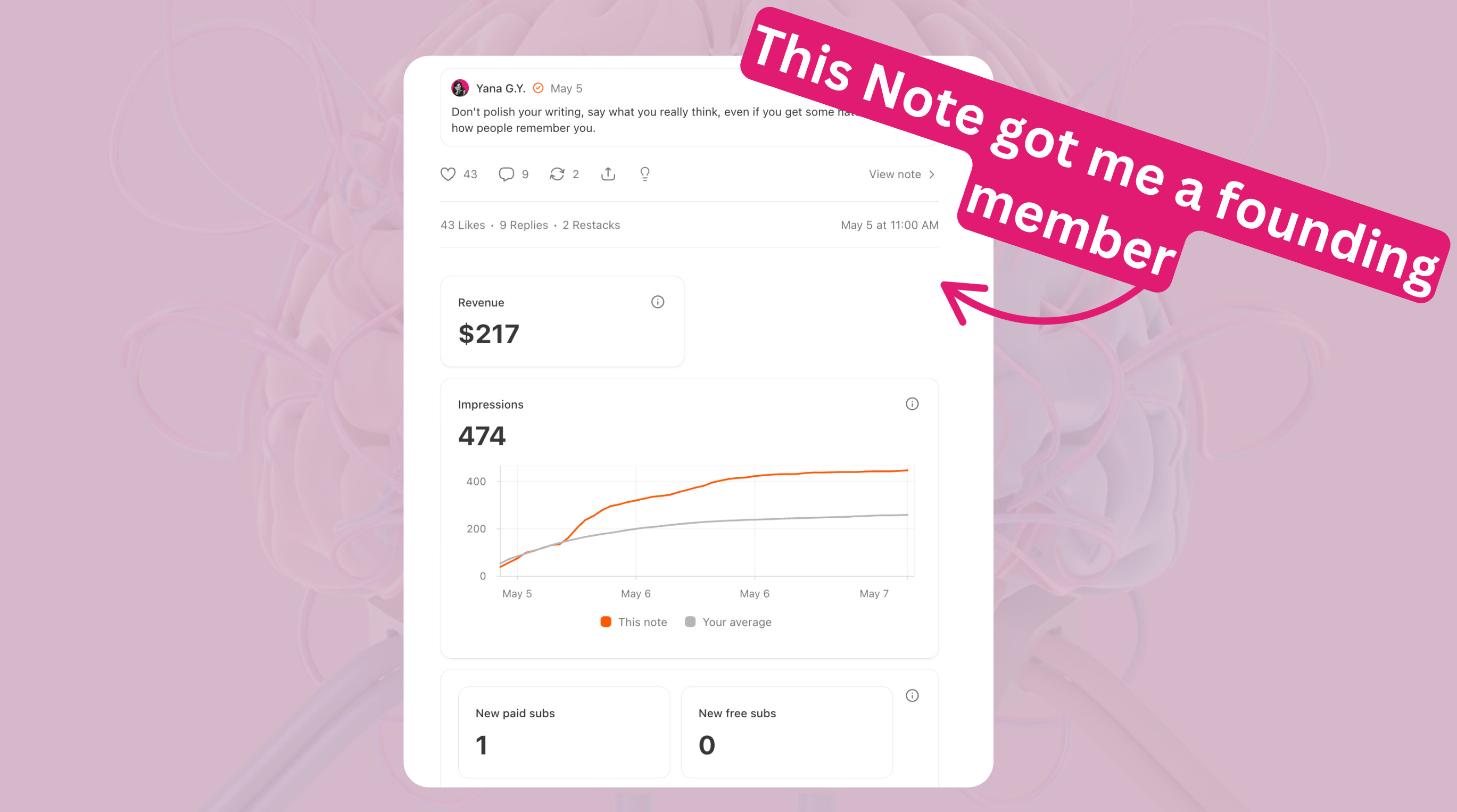
43 likes. 9 replies. 2 restacks. Definitely not viral.
By the next morning, that Note had brought me a founding member.
Look. I’ve had Notes pull thousands of likes. This wasn’t one of them. The question is this: would you rather have 10,000 likes or one founding member?
Here’s what most writers do with Notes
They chase likes. They chase restacks. They study what went viral this week and copy the structure. They post motivational opinions, screenshot quotes from their favourite books, and write “controversial takes” that aren’t actually controversial. They watch the heart count climb.
But they don’t convert.
And so they conclude Notes don’t work.
Notes work. The way most writers use them is the problem.
I ran a deep analysis of my own Notes data using my StackContacts database by Finn Tropy | StackContacts.
The pattern is clear: the Notes that get the most likes are almost never the Notes that bring the most subscribers.
Engagement and conversion don’t predict each other.
This is key.
If you write for engagement, you get engagement. If you write for conversion, you get subscribers. They’re two different things.
What converting Notes feel like
You stop refreshing for hearts. You start checking for new subscribers and paid member notifications.
Every Note becomes an opportunity to pull someone into your paid world. Even if they become free subscribers, your funnel will do the rest. Some upgrade on the spot. Others within a few days.
A 43-like Notes can pay a few bills.
The viral ones are a bonus.
My 3-pillar Substack Notes framework that brings subscribers consistently
Here’s my three pillar system that brings consistent subscribers growth:
The right format - what’s actually in the Note
The right volume and timing - how often you post and when
The right visibility - where you spend the rest of your time
Most writers get one of these right and wonder why nothing’s working. Get all three right and the math starts mathing. Fast.
The full breakdown is below. And I made you the printable one-pager so you don’t have to remember any of this. Keep it open every time you sit down to write a Note.
Pillar 1: The right format
This is where most Notes lose their conversion power.
Writers post quick takes. Motivational lines. Random thoughts. Stuff that gets hearts because it’s easy to scroll past and double-tap.
That works if you want hearts. Subscribers act on a different format.
Here’s the checklist for every Note I publish.
I incorporated all of these rules in my Custom GPT and my Claude skill, so you don’t have to stare at the screen guessing. Just give the AI your idea, and you get your Notes drafted for a week.
The “converting Note” checklist
1) No links. No sales pitches. No CTAs. Substack’s algorithm doesn’t punish links in Notes, but they just don’t convert. And a “Subscribe!” prompt repels the exact reader you want. Be interesting enough that they go find your Substack on their own.
2) Pull snippets from your latest paid post. Your paid posts are the meatiest content you produce. Tease them. Quote them. Show a paragraph and let the reader decide they need the rest. This single move turns Notes into a paid-post promotion machine that doesn’t feel like promotion.
If you want my full workflow for turning one idea or a paid post into 21 Notes with my Claude skill, here’s the walkthrough:

3) Hit the same problems your paid offers solve. Every Note should orbit the problems your paid product addresses. If you write about fitness for busy parents, every Note should touch tiredness, time scarcity, identity loss, or kids derailing your routine. Stay in your lane. AI and humans both learn faster what you’re about when you stop wandering.
4) Show milestones with screenshots. Revenue screenshots. Subscriber jumps (this attracts new subscribers to you, even if you don’t write about Substack growth). Course sales. A great comment from a buyer. Specific, dated, real. This is your social proof working without you saying “look at my social proof.”
5) Use conversation starters that filter. A good Note attracts your ideal reader and repels the wrong one. The May 5 Note above actively filtered. Writers who want to “polish” their work scrolled past. Writers who want to be remembered stopped and replied. The 9 replies were exactly the right people.
6) Stories, stats, contrarian tips. Then opinions. Opinions get hearts. Stories, stats, and tips bring subscribers. A specific moment from your week with a concrete takeaway converts. “Hot take: hustle culture is dead” doesn’t. Lead with the specific. The opinion only earns attention after the specific has done its job.
I built this format into my Claude skill and my Custom GPT for writing Notes.
Pillar 2: The right volume and timing
Most Substack gurus say 3 to 5 Notes per day.
I post 10.
Here’s the truth:
Every Note is an opportunity for a new subscriber. If you post 3, you get 3 opportunities. If you post 10, you get 10. The maths is brutal.
Now. You can’t post 10 thoughtful Notes per day from a blank page. That’s a full-time job. I don’t have time for it and neither do you.
What I actually do: I batch. Once or twice a week I sit down, generate 30 to 50 Note ideas from my existing paid posts using my Custom GPT and Claude skill, write them out, and schedule them.
Simple rule: every Note in the batch should map (not link) to a specific paid post or a specific problem your reader cares about.
The scheduling:
I schedule Notes in US active hours, roughly 8am to 9pm EST. That’s where the bulk of paying Substack readers live. My time zone in Europe is irrelevant. Their time zone is everything.
Even when I’m asleep, my Notes are showing up in feeds in New York, Chicago, and LA. That’s when conversion happens.
I use Finn’s Substack Studio Pro to analyze best times to post.
Pillar 3: The right visibility
This is the pillar nobody talks about. And it’s the reason most writers stay invisible no matter how good their Notes are.
You have to help your Notes, especially if you have a small audience. This is my breakdown about how Notes get traction or don’t:

Posting a Note isn’t visibility. It’s publishing. Two different things. Here’s what visibility actually means.
Stay active in chats of big newsletters in your niche. Find the 10 to 15 newsletters with the biggest paid audiences in your space. Subscribe to their chats. Show up. Add real value, ask real questions. People click your name from the chat and land on your Substack. Some read your Notes. Some subscribe immediately.
Search for your ideal paid subscribers and help them. Substack’s search works. Type the problem your paid offer solves. Find people posting Notes about that problem, searching for help. Or find other newsletters that talk about similar problems and see what happens in their chat space. Reply with a genuinely useful answer. They click. They subscribe. Some convert on the spot.
Like, comment, and restack their Notes and posts. Pick a few writers whose readers overlap with yours. Engage with their stuff every day. Real engagement, not spray-and-pray. They notice. Their readers start mentioning you in their own comments.
Subscribe to and recommend others. Recommendations are the most underrated Substack growth lever. Go and recommend people you love. Some recommend back. That’s where free subscribers come from in volume. And free subscribers become paid subscribers when you have the right conversion engine.
Answer every comment. Every single one. People subscribe to people, not to publications. If someone takes 30 seconds to comment on your Note, you owe them 30 seconds back. Those people are your future paid subscribers far more than the silent likers.
Bottom line
Notes convert when you stop writing for likes and start writing for the right reader.
Format filters the wrong readers out. Volume gives the algorithm enough data to find your people. Visibility puts you in front of writers whose audiences are already paying for content in your niche.
My 43-like Note from May 5 isn’t an outlier. It’s a system working as designed. Most of the people become free subscribers, some become paid. This Note is the proof.
The format filtered. The timing put it in front of US readers. The visibility I’d built over the previous weeks meant a founding-member-ready reader was already in my orbit when they saw it.
That’s it.
Your Substack Notes that Convert Cheat Sheet
I made you a printable one-pager cheat sheet with the full 3-pillar framework on a single page. Print it. Keep it next to your laptop. Run every Note through it before you hit publish.
FAQ — Substack Notes that convert paid subscribers
Do Substack Notes actually bring paid subscribers? Yes, as the Note above. Even if they bring mostly free subscribers, these subscribers are your goldmine. My current free-to-paid conversion rate is 9.2% and the highest I’ve seen is 11.7%, well above the typical Substack average.
How many Substack Notes should I post per day to grow paid subscribers? Substack gurus recommend 3 to 5 Notes per day. I post 10. Every Note is an opportunity for a new subscriber, so volume matters. But only if you batch the work and run a format system. Posting 10 unsystematised Notes per day burns you out by week three.
What’s the difference between Substack Notes that get likes and Notes that convert? Engagement and conversion don’t predict each other. The Notes that get the most likes are almost never the Notes that bring the most subscribers. Likes-Notes are usually opinions and motivational lines. Converting Notes are specific stories, stats, and contrarian tips that filter the right reader and tease snippets from your paid content. My AI tools are designed to help with both, but I mostly use them for Notes that convert.
When should I schedule Substack Notes for maximum conversion? Schedule in US active hours, roughly 8am to 9pm EST, regardless of your own time zone. That’s where the bulk of paying Substack readers live. I’m in Europe. My Notes still convert best on US time.
Should I include links or CTAs in my Substack Notes? No. Substack’s algorithm doesn’t punish links in Notes but they simply don’t convert. And a “Subscribe!” CTA repels the exact reader you want. Make the Note interesting enough that the right reader goes finding your Substack on their own.
Yana
P.S. Remember to get the Viral Notes Writer Claude skill and use Opus model to get the best high-converting Notes drafted for you in seconds.
👉 Start a discussion in the Unplugged community! Get help or simply introduce yourself and connect with like-minded members, and create meaningful connections.
Kickstart Your Substack Growth:
Get Your FREE High Converting Substack Blueprint
Get a FREE 10-Day Substack crash course to grow your first 1000 subscribers
Join my FREE Masterclass on how to start making consistent $5,000+/month
Join the One and Only Substack Quest to build a high-converting Substack
Work with me to get your Substack up and growing
Save Tons of Time! Use My Custom GPTs:
The Title Generator that gives me headlines that stop the scroll
The Notes Writer that writes Viral Notes, bringing me and my paid members hundreds of subs
The Writer Pro that turns my Notes into >90% human drafts (here’s the free version).
Or get the bundle with all the tools, now at a very special price ;)
Become an Affiliate:
Earn 30% from each sale. Apply below, I approve everyone.
Apply here for my AI tools & templates
Apply here for the SUBSTACK QUEST courses
Become a sponsor:
Reach thousands of engaged buyers.
More from me:
FREE Daily BiTES: A daily mail with just 3 bullets from the most helpful things I read about writing and making money online with AI
Unplugged: The place to be if you want to grow an AI-powered paid newsletter and create content that sells itself.
It's a treat to see someone with Yana's professional expertise explain their own built in marketing and writing process in such a clear and open way. Yana makes it easy for others to use. It’s written by someone who understands how both writing and growth work. It’s one of the clearest marketing breakdowns I’ve read.
Subscriber growth comes from consistent value and clear positioning, not just chasing engagement metrics