


If you came here for a number, here it is: the average Substack free to paid conversion rate is lower than Substack tells you (but i’m not saying they mislead you).
Substack’s own guidance says 5 to 10%, with 10% as the rate to aim for.
I have analyzed 100+ successful paid newsletters and the highest I’ve seen goes beyond 20% (yes, not a joke!).
Others have pulled together real publication data from what authors share publicly (Casandra Campbell’s running dataset is the best public one I’ve found), and the median lands around 3%, and only about 1 in 5 publications clears 5%. So the honest band for most of us is 2 to 5%.
Which is close to the industry average of 1% to 3%.
Ok, that’s the headline. Now the part that took me longer to understand.
Free to paid conversion rate is the share of your free subscribers who upgrade to a paid subscription.
Most people calculate it as one blended number: total paid divided by total free. I stopped doing that a while ago, because the blended number was hiding the only thing worth knowing - how this breaks down by acquisition channel.
I calculate it by where the subscriber came from.
And the spread between channels is so wide that the word “average” almost stops meaning anything.
My free to paid conversion rate, by acquisition channel
Here’s 13 weeks of my own data, split across the three places my subscribers actually come from.
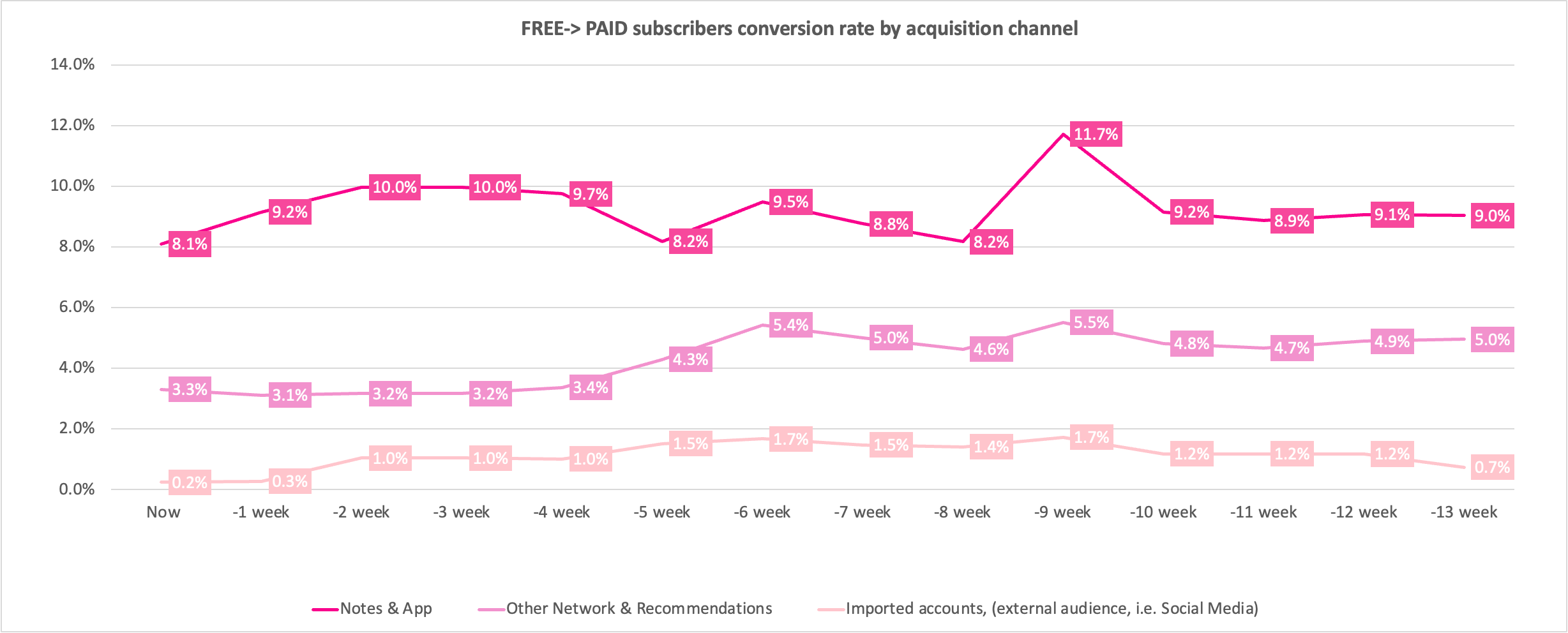
Three lines, three completely different stories.
Notes & App sits around 9.3% on average. It has dipped to 8.1% and once hit 11.7%. This is people who found me on Substack itself, read a Note, clicked through, and subscribed because something I wrote made them want more. These people are looking to subscribe and upgrade to paid. That’s the beauty of the community on Substack. And that’s why Substack doesn’t mislead you by saying it’s 5% average with 10% being the one to aim for.
Other Network and Recommendations averages about 4.4%. These are subscribers who came through another writer’s recommendation or the broader Substack network. Warm, but a step removed. They subscribed partly because of me and partly because the path was easy.
Imported accounts (external audience I imported, mostly social media) averages about 1.2%. These are people I brought in from off-platform. Lowest intent by a wide margin and that’s what I expect. These people are not into subscriptions.
So my best channel converts roughly seven to nine times better than my weakest one. Same publication, offer, paywall and writing.
The only variable is how the person arrived.
This is why I take it with a grain of salt when someone quotes a single “Substack average.”
Your number is a weighted blend of how your traffic splits across high-intent and low-intent sources.
Change the mix and the blend moves, even if your actual offer never changed.
Why the channel matters more than the average
The pattern behind all three lines is intent.
Someone who reads a Note, likes how I think, and clicks through to my publication is already half-sold. They came looking. By the time they hit a paywall, the question in their head is “is this worth it,” not “who is this person.”
Someone who got pulled in by a one-click recommendation after subscribing to a different newsletter is curious but uncommitted. And some don’t even notice they subscribe to you. They didn’t go looking for you. They said yes to a low-friction prompt.
Someone I imported from social media is the coldest of the three. They followed me somewhere else, for some other reason, and an email subscription was never the thing they signed up for. That type of import I don’t do anymore, I found a better way to grow from social media, but more on that in my monthly round-ups where I my exact revenue and growth numbers and what I do to get there.
Substack keeps adding features that make subscribing frictionless: one-click subscribe from Notes, recommendations at checkout, the shared logged-in account.
They’re all useful, but the easier you make it to subscribe, the lower the average intent of the people walking in. You grow your free list faster and your blended conversion rate drifts down at the same time. Both things are true at once.
So. When you understand the channel mix, you stop panic about the average, and stop comparing your number to the wrong benchmark.
What’s actually a good free to paid conversion rate on Substack?
Here’s how I read the bands, using my data, the public reports together and having in mind the industry averages:
Under 2% usually points at a weak or unclear paid offer, or a list that’s mostly low-intent subscribers.
2 to 5% is normal. This is where most publications actually live, including the median I’ve seen around 3%.
5 to 8% is good. You have a real offer and a reasonably warm audience.
8 to 11% is strong. My Notes & App channel runs here. It takes high-intent traffic and a paid offer people genuinely want.
Beyond 11%, and in rare cases past 20%, happens with a small, tight, high-intent audience and a paid offer that’s closer to a product than a paywall. These are outliers. There are some exceptions of course. Real, but outliers. If you’re at 3% and someone is at 22%, you are not running the same kind of publication, and copying their tactics won’t move you there.
So. If you’re sitting at 3%, you’re average. That’s the literal definition. The million dollar question is do you want to stay there? That’s the core problem I help people solve in my coaching program.
How to increase your free to paid conversion rate
Four levers move this number. Most people only pull one.
By the way, if you’re looking to increase yoru conversion rate, here’s my blueprint:

Now, here are the levers…
Lever one: convert from your high-intent channels
If your Notes audience converts at 9% and your imported social audience converts at 1%, the fastest gain is getting more of your growth to come through the 9% channel. For me that means writing more on Substack itself, in Notes and in posts, instead of pouring energy into importing cold followers from elsewhere or running paid ads (unless they convert at rates above 3%). The volume looks smaller. The paid revenue per subscriber is far higher.
The best way to grow a Substack native audience is to stay active on the platform. The biggest growth sources are Notes and recommendations - so write Notes every day, I’d say 3-5 Notes per day. Then make sure you answer your comments and start engaging with others - like, comment, restack their Notes.
Subscribe and recommend them, some will recommend back.
Stay active in bigger newsletter’s chats - the whole point is to get more exposure to your profile so that people start noticing you and subscribe.
You can also reach out to people in the DMs and explore a potential collaboration. The best conversation starter would be about something they wrote recently.
I go deep into this here:

Track by channel and this becomes obvious. Track only the blended number and you’ll keep working on the wrong thing.
Lever two: build a paid offer people actually want, then ask for the upgrade in the right places.
Locking your posts behind a paywall is not the same as having an offer. “More of my posts, but locked” converts poorly because the reader can’t tell what they’re buying.
A strong paid offer is specific. A named series. A working tool or template. A monthly thing they’d miss. Something where a free reader can describe what they get the second they pay.
Then make the ask, not directly, but with a soft, specific line at the moment a reader is most convinced, usually at the end of a post that already gave them something useful. Give the value first, ask second. The ask converts because the value already landed. Here’s how I do it:

Lever three: let automation do the asking, so conversion doesn’t depend on your memory.
The problem with asking by hand is that you forget. Or you get shy. Or you get busy and three weeks of new free subscribers never hear about the paid version at all.
Problem is, they get colder. And you lose momentum on conversions.
An automated welcome sequence fixes that. Every new free subscriber gets the same set of emails that introduce you, give them something useful, and make the case for upgrading, on a schedule, with you not touching it. The conversion happens whether you wrote anything that week or not.
I built a Claude skill to write the whole sequence for me, so a new subscriber gets walked from “who is this” to “I want the paid version” over their first couple of weeks, in my voice. You can get that skill here:

Lever four: set your Substack up to convert before you chase more traffic.
A lot of the conversion is decided before anyone reads a single post. Your About page. Your welcome page. How your paid offer is described on the subscribe screen. Where your paywalls sit. What a free reader sees in the first ten seconds. If those are vague, even high-intent traffic leaks out before it ever reaches the upgrade button. I help people do that in my coaching program and the results are visible.
When the levers work together, the number climbs on its own. More high-intent traffic, meeting an offer worth paying for, on a Substack set up to convert, with the asking handled in the background.
How do I calculate my free to paid conversion rate?
Inside Substack: go to Dashboard, then Stats, then Network. You can see subscribers grouped by source. Take your paid subscribers from a channel, divide by your total subscribers from that channel, and you have the conversion rate for that channel.
Do it for each source, not just the total. The blended number tells you where you stand. The channel numbers tell you what to do about it.
In short
The average Substack free to paid conversion rate is around 3%, and 2 to 5% is normal, well below the 5 to 10% Substack quotes.
But that single average hides the channel split that drives it.
Mine moves from about 9.3% on high-intent Notes & App traffic down to 1.2% on imported social, with the same writing and the same paywall. So benchmark against your own channels, not one headline figure.
To move the number: send more of your growth through high-intent channels, give people a paid offer they can describe in one sentence, let an automated welcome sequence do the asking, and set your Substack up to convert before you chase more traffic.
Get those four working and 8 to 11% is reachable. Past that is rare, and that’s fine.
TL;DR
Substack’s official guidance is 5 to 10%. The median across public data is around 3%, and most publications convert 2 to 5% of free subscribers to paid.
Your conversion rate depends heavily on where subscribers come from. My free to paid conversion rate runs about 9.3% from Notes & App, 4.4% from network and recommendations, and 1.2% from imported social traffic.
Strong publications hit 8 to 11%. Past 20% happens, but it’s rare and usually means a small, high-intent audience with a product-grade paid offer.
Four ways to raise it: pull more growth from your high-intent channels, build a paid offer people can actually describe, automate the asking with a welcome sequence, and set your Substack up to convert before chasing more traffic.
FAQ
What is the average Substack free to paid conversion rate? Around 3% as a median across public data. Most publications fall between 2 and 5%. Substack’s official guidance of 5 to 10% sits above what the typical publication actually sees.
What’s a good free to paid conversion rate on Substack? 3 to 5% is solid and normal. 5 to 8% is good. 8 to 11% is strong and usually needs high-intent traffic plus a real paid offer. Past 20% is rare and tends to be small, niche publications with product-grade offers.
Why is my Substack conversion rate low? Usually one of three reasons. Your audience is mostly low-intent (imported from social, or one-click network subscribers), or your paid offer is vague and readers can’t tell what they’re buying, or you’re not promoting it enough. Often a combination of all of this.
Can you really hit an 11% free to paid conversion rate? Yes. My Notes & App channel has, and runs near 9% most months. It takes traffic from people who found you on purpose and a paid offer they want. It’s a lot harder to hit across a blended list that includes cold imports.
Yana
P.S. If Substack still feels overwhelming, check out this link.
👉 Start a discussion in the Unplugged community! Get help or simply introduce yourself and connect with like-minded members, and create meaningful connections.
Kickstart Your Substack Growth:
Get Your FREE High Converting Substack Blueprint
Get a FREE 10-Day Substack crash course to grow your first 1000 subscribers
Join my FREE Masterclass on how to start making consistent $5,000/month
Join the One and Only Substack Quest to build a high-converting Substack
Work with me to get your Substack up and growing
Save Tons of Time! Use My Custom GPTs:
The Title Generator that gives me headlines that stop the scroll
The Notes Writer that writes Viral Notes, bringing me and my paid members hundreds of subs
The Writer Pro that turns my Notes into >90% human drafts (here’s the free version).
Or get the bundle with all the tools, now at a very special price ;)
Become an Affiliate:
Earn 30% from each sale. Apply below, I approve everyone.
Apply here for my AI tools & templates
Apply here for the SUBSTACK QUEST courses
Become a sponsor:
Reach thousands of engaged buyers.
More from me:
FREE Daily BiTES: A daily mail with just 3 bullets from the most helpful things I read about writing and making money online with AI
Unplugged: The place to be if you want to grow an AI-powered paid newsletter and create content that sells itself.
Thanks Yana, good post 🫡
I’ve got a 26% conversion rate and definitely need to take a look at my best acquisition channels - and take advantage of the email funnel strategy! Still have not yet set that up. 🫠 Thanks for this post!