


One of the questions I see most often from new writers on Substack:
When should I enable paid subscriptions?
The million-dollar question, right? Just yesterday I got that again, so I decided to write this piece.
But before deep-dive into this, I’m curious:
Ok, so this feels like a tactical question, right?
One that should have a clear answer. Maybe a subscriber milestone, maybe a timeline, maybe a specific signal that tells you the moment has arrived.
I remember it was the same with me when I started. Too many options come to your mind.
Let me guess…
Immediately, the moment I launch my publication
Maybe six months after I started
When I hit 10,000 subscribers
When I feel ready
Never?
And if you look for some advice?
Almost nobody explains why.
But the truth is much simpler.
The timing of your paid tier has very little to do with subscriber numbers or time passed. It has everything to do with what problem you are solving and how you plan to monetize it.
The trap most people fall into
The most common approach.
Someone launches a newsletter. They begin writing consistently. They post content, experiment with ideas, and slowly grow their audience.
And just before they make the switch, they start hearing the advice.
“Don’t enable paid yet.”
“Wait until you have a bigger audience.”
“Focus on growth first.”
“Your subscribers will leave if you paywall.”
So they follow that advice. They keep publishing. They keep gaining subscribers. And they postpone monetization until some vague milestone arrives.
It feels like a safe decision. It sounds responsible, like you’re focusing on the audience first.
But there’s a hidden risk most people don’t notice until it’s far too late…
You might be building the wrong audience.
When people subscribe to your publication without ever seeing a paid offer, they assume the content is meant to stay free.
They subscribe expecting free learning, insights, ideas, or entertainment.
They don’t subscribe, expecting to buy something later. Only you do.
So what happens when you finally introduce a paid tier months down the road?
Some readers feel surprised. Some feel confused. And some quietly unsubscribe because the value exchange changed. Or worse: because the paid tier is not what they signed up for.
The problem isn’t that you introduced monetization.
The problem is that the audience expectation was built around something else. Something different from what you decided to monetize.
And expectations are surprisingly hard to change once they’ve been established.
The “wait till 10K subscribers” myth
This is probably the most common piece of advice I see floating around Substack.
It sounds reasonable. With a bigger audience, you have more potential buyers. Even a small conversion rate would produce meaningful revenue.
The problem with that thinking?
It assumes that audience size is the main driver of conversions.
And I hate to assume.
You know me, I lean on data.
And there’s zero data proving this.
Look at conversion rates.
Most people with bigger accounts are gravitating around 1% to 3%, 5% if they’re more active in selling and have a good paid offer.
It’s usually a sign they have an external audience - because that’s the normal conversion rate outside Substack.
On Substack? People are just different. They expect to become paid. It’s even sometimes addictive.
I track my conversion rates very closely:
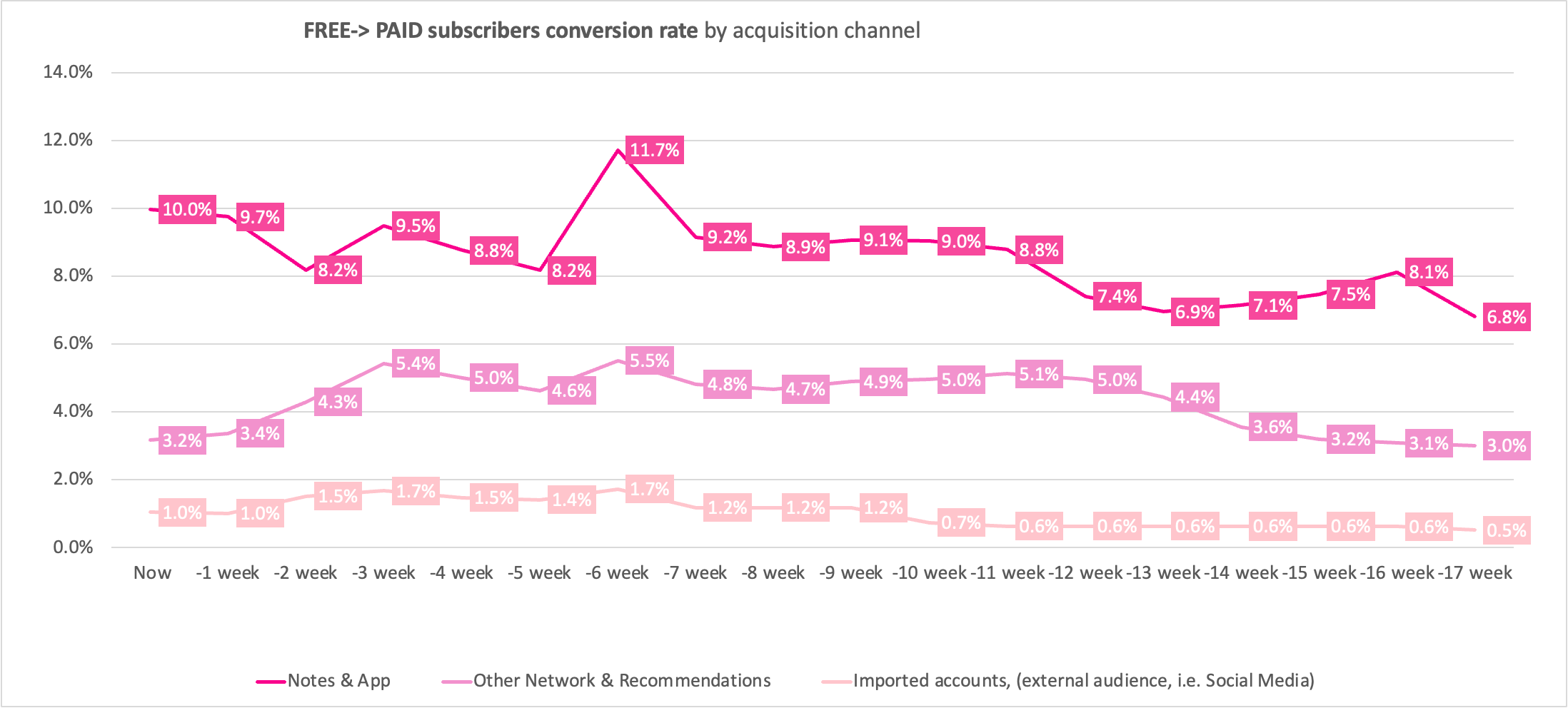
That’s why people with Substack native audiences have high conversion rates, like this one for example:

My data shows that conversions don’t depend on volume, but on something else: If your audience subscribes because they care about the specific problem you help them solve, even a small group of readers can convert surprisingly well.
But if people subscribe because your content is interesting or entertaining, without ever connecting to a deeper problem you solve, the conversion rate will stay extremely low no matter how large the audience becomes.
No matter how entertaining you are.
No matter how much “value” you think you give.
You can easily grow a newsletter to several thousand readers and still struggle to sell anything.
And it’s not because your audience is small, it’s just not here to pay you.
This is why many newsletters with tens of thousands of readers make very little money, while others with a few hundred subscribers generate meaningful income.
It’s not the size.
It’s the structure behind the content.
The “wait at least six months” advice
I don’t even know where this comes from, honestly…
My guess: people assume Substack is a sandbox - you have zero clue how this works so you go all in trying to figure it out.
“I’ll write to find my voice first.”
“I’ll figure this out on the go.”
As if you bought the newest model of a tech gadget you never touched before, and you start using it without even reading the manual (I do that all the time by the way).
But Substack is not a playground. Medium is the better place to find your voice. Why? Because on Substack you have subscribers - people you directly connect with. People who count on you for something specific.
It’s not the place to write for three months.
Or six months.
Or a full year.
Then enable paid.
The question I always ask when I hear this advice: What exactly changes during that time?
Does the business model magically appear?
Does the offer suddenly become obvious?
Does the reader automatically turn into a buyer?
Not really…
Time alone doesn’t create a monetization strategy.
You can easily spend months publishing content without ever defining the problem you want to solve or the product you want to build.
And when that happens, enabling paid subscriptions later doesn’t solve the underlying issue.
It simply exposes it.
Because readers don’t pay for content just because it exists. They pay because it helps them move closer to something they want.
The other extreme: go paid immediately
This is actually what Substack itself recommends. And to be honest, I do believe in this as well. And I say this all the time.
And there is a good reason behind this.
When paid exists from the beginning, readers understand the structure of the publication right away. They see that there is a free layer and a deeper paid layer.
Nothing feels surprising later.
But even this approach has a risk.
Turning on paid subscriptions without a clear positioning strategy is like opening a store before deciding what products you want to sell.
The checkout works.
The payment button exists.
But the offer is still unclear.
I see this all the time when I do Substack reviews. I’ve summarized how to optimize your Substack for a high conversion rate here:

Write2Sell: The 2026 Substack Conversion Blueprint (26 Optimizations That Actually Move the Needle)
When your offer is unclear, people might see the paid option, but they don’t understand why it exists or what they would gain from upgrading.
And if that’s the case, the paid tier becomes little more than a feature that sits quietly in the corner.
This is why most writers who turn on paid from the beginning still struggle to get conversions.
The problem isn’t the timing.
The problem is the lack of a monetization structure behind the publication. I’ve mapped the one that I’m using for me and for my 1:1 clients here:

Substack is not a practice platform
There is another important distinction that many people overlook.
Some writers start a newsletter simply to practice writing online.
To build confidence.
To get comfortable publishing.
To experiment with ideas.
And that’s completely valid.
Writing is a skill. It improves through repetition. Publishing regularly is one of the fastest ways to learn how to communicate clearly and hold a reader’s attention.
But if your goal is primarily to learn writing, monetization shouldn’t be the first thing you worry about.
First you develop the craft.
You learn how to structure ideas.
You learn how to keep readers engaged.
You learn how to explain complex topics in a simple way.
I’d pick Medium as a platform to do this, but I wouldn’t expect stable income (if at all). If you want to skip the learning curve, here’s how you can learn the skill of writing online:

Once that foundation exists, monetization becomes much easier to build on top of it.
Because trying to build a business before developing the core skill can feel frustrating because the pieces are being assembled in the wrong order.
The framework that actually works
After experimenting with different approaches for about 2 years (mostly on Medium), after deep research on Substack, and after a 2-month strategy exercise backed by my 15+ years of experience in product and marketing, selling subscriptions in my 9-5, I eventually settled on a much simpler way of thinking about this problem.
Instead of asking when to enable paid subscriptions, ask something more important first: What problem am I solving?
Once you answer that question clearly, everything else becomes easier to design.
I’ve mapped this in greater detail in the QUEST:

Here is the process I use.
Step 1: Start with the problem
Not the audience.
Not the product.
Every successful paid newsletter solves a specific problem.
Not a broad topic.
Not a general interest.
A real, tangible problem that people actively want to solve. The more painful the better. The more specific the better.
When you define the problem clearly, you also define the people you are trying to help. No need of avatars, personals and all that old school marketing crap.
I’ve mapped this in greater detail in the QUEST:
Step 2: Build the product
Now, I hear you: “But Yana, why not the audience first”.
Because I say so.
Ok, I’m kidding.
Because you risk of growing people who have no clue what you’re selling and chances are they won’t buy it in the future.
So, before focusing on audience growth, it helps to have a clear direction for what you eventually want to sell in your paid subscription.
This doesn’t need to be complicated.
Your product could be:
A structured framework you deliver every Tuesday
A course you build in public
Templates and tools
A community
Deeper educational, research or analysis content
Or a combination of all of the above.
What makes it highly convertible is to have enough clarity in your paid tier and make it tangible. The more tangible the better.
Why?
Because people want to feel a sense of ownership after purchase - simple human psychology.
Once you know the solution you want to offer, your content becomes much easier to structure.
Instead of publishing random posts, you are building toward something specific.
You’re building a real business.
I’ve mapped this in greater detail in the QUEST:

Step 3: Build the monetization content
Now you design the content that is in your paid offer. The one you put behind the paywall.
This type of content does several things at the same time.
It teaches important ideas.
It demonstrates your expertise.
It shows proof that your thinking works.
It builds trust faster than you think. Faster then your free content for sure.
And trust is the real foundation behind every paid subscription.
People start seeing patterns in your work. They begin to understand how you approach problems and how your frameworks help people move forward.
Step 4: Build the growth content
Once the monetization structure is clear, you can design content specifically aimed at attracting new subscribers. That is free posts and Notes.
These pieces usually solve smaller parts of the same problem your product addresses, or connected less painful problems.
They attract readers who are already struggling with that problem.
Which means the people entering your audience are much more likely to care about the solution you offer.
That’s how you make sure you grow an audience ready to pay.
I’ve mapped this in greater detail in the QUEST:

Step 5: Build your audience
Yes, the audience comes last. Because it’s the hardest part - where you actually do the work and stay consistent.
Most people give up when they face the wall (which is part of the journey). That’s why I run monthly challenges in my Unplugged community - to help you stay consistent.
Trust doesn’t appear overnight.
People need time to observe your thinking, your frameworks, and especially your results. They need to see that your ideas hold up across multiple examples.
This happens through consistent publishing.
Through case studies.
Through experiments.
Through honest explanations of what works and what doesn’t.
Over time readers begin to recognize your perspective.
And that recognition creates credibility.
Step 6: Talk about the offer regularly
This is where many writers hold themselves back.
They build something valuable but hesitate to talk about it.
Maybe they don’t want to sound salesy. Maybe they worry readers will lose interest if they mention a paid offer too often.
But readers aren’t mind readers.
If you want people to know there is a deeper level available, you have to mention it. Regularly. And repeat it again and again and again.
Not aggressively.
Just consistently.
Your offer should appear naturally throughout your content as the logical next step for readers who want to go deeper. That’s how you sell without selling, and convert at high rates. If you want an example, look at this post ;)
That’s the #1 paid of most writers on Substack and because of that I’ve built the Write2Sell column.
What happened when I applied this
When I launched my newsletter, I enabled paid subscriptions immediately.
Not because I had a huge audience. I actually had about 60 real subscribers I imported from my writing on Medium, and about a thousand cold ones I’ve gained through the years of testing different things to make money online.
But because the structure behind the publication was already clear.
I knew the problem I wanted to solve.
I had a product direction in mind.
And I understood how the content would connect to that offer.
And something interesting happened.
Almost immediately, I gained three paid subscribers.
Three people decided to pay for my brand new publication.
Now, that number might sound small.
But the number itself wasn’t the important part.
What mattered was the signal.
Three people looked at the idea and thought, Yes, this is worth paying for.
That was enough proof to know the direction was correct.
I’ve talked to Anfernee about this in his “First Digital Dollar” project - it was one of the best lives I had so far.
From there, the focus became simple.
Keep building the system.
Keep strengthening the connection between problem, product, and audience.
And let the results compound.
That’s the foundation that brought me to my first bestseller badge within about 3 months. I wrote about this here:

The real answer (TLDR version)
So when should you enable paid subscriptions?
Not when you reach a certain number of subscribers.
Not after a specific amount of time.
Not never.
It’s a great source of stable monthly revenue that compounds.
And the real moment to do it is when four things are clear:
You understand the problem you help solve
You have a product or direction that addresses it
Your content structure supports that solution
You have enough content to begin building trust
Once those pieces exist, there’s no real reason to wait.
Enable paid.
And start learning from the people who are actually willing to invest in your work.
Yana
P.S. If Substack still feels overwhelming, check out this link.
👉 Start a discussion in the Unplugged community! Get help or simply introduce yourself and connect with like-minded members, and create meaningful connections.
Kickstart Your Substack Growth:
Get a FREE 10-Day Substack crash course to grow your first 1000 subscribers
Join my free Masterclass on how to start making consistent $5,000/month with AI
Join the One and Only Substack Quest to build a high-converting Substack
Work with me to get your Substack up and growing
Save Tons of Time! Use My Custom GPTs:
The Title Generator that gives me headlines that stop the scroll
The Notes Writer that writes Viral Notes, bringing me hundreds of subs
The Writer Pro that turns my Notes into >90% human drafts (here’s the free version).
Or get the bundle with all the tools, now at a very special price ;)
Become an Affiliate:
Earn 30% from each sale. Apply here (I approve everyone).
My Newsletters:
FREE Daily BiTES: A daily mail with just 3 bullets from the most helpful things I read about writing and making money online with AI
Have a GUT Time: A weekly short but powerful technique to build a growth mindset and achieve anything you want
Unplugged: The place to be if you want to grow an AI-powered paid newsletter and create content that sells itself.
Become a sponsor:
Reach thousands of engaged buyers.
Girl 3 seconds✨Three seconds into reading ❤️🔥❤️🔥❤️🔥
Hey, I just want to share something with you. I loved this immediately. That was the cleanest , smoothest introduction ever.