


Layla runs an enterprise software company she co-founded out of MIT.
She also has 145,000 subscribers on Substack.
And when she turned on the paywall? People didn’t exactly start throwing money at her.
So she asked me the question I hear from almost every creator on Substack:
How do I make money on Substack when I’m selling my ideas and not a service?
The million-dollar question, right?
The replay is in the video. This post is the written version, with the numbers and a challenge we gave everyone on the live:
Apply one thing you learned from me on that live
We’ll do another live on 7th of December
Join that live and share what your results are
I can’t wait for our next live. But before that…
Where I would start if I was Layla
You have data. Use it.
With 145,000 subscribers you already have more signals than most people will ever get. Comments, replies, which posts get shared, which questions keep coming back. I would dig into all of it and look for what the audience is actually asking for.
Then I’d shape the paid membership around that.
Take your best ideas and turn them into a framework. Something structured. Something that solves a recurring problem. Give it a name (like my Quest). Put it behind the paywall and keep delivering on it.
Because essays behind a paywall won’t ever sell.
You have to have a good answer to the question “What’s in it FOR ME?”
Your biggest fans will pay to support you, and that’s completely valid. But that’s a tip jar. It won’t build a viable income.
Just like Layla said “This is sales at the end of the day.”
The shortcut I wish I had when I started
Before I continue, let me introduce you to a book I recently got, which I think is amazingly helpful when you try to monetize your ideas.
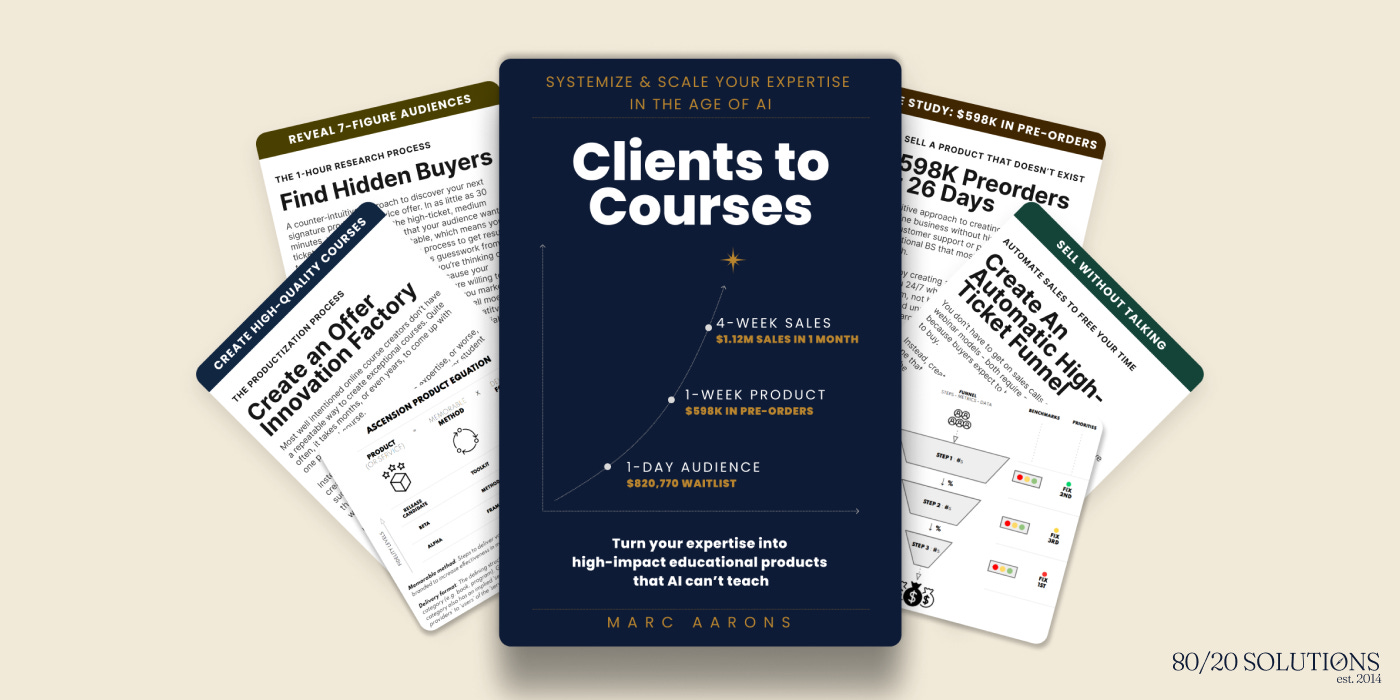
Clients to Courses by Marc Aarons is about exactly the thing I was trying to explain to Layla: how to take expertise you already have and turn it into an educational product people actually pay for.
His numbers: 10 weeks from product idea to launch, $598K in sales, then $0 to $4M in 10 months.
But the part I loved most: they start with proof.
That’s the same rule I follow with my business. Inside the book you’ll find how to find hidden buyers in your audience, how to build a repeatable product system, how they sold a product before it existed, and how to set up an automated high-ticket funnel.
If you have expertise and a list but no product yet, start here:
This section is sponsored by 80/20 Solutions. I got the book myself and it’s amazing value, which is why I said yes to this partnership.
Ok, back to my conversation with Layla.
Why most Substacks don’t convert?
They optimize for the wrong person.
I’m obsessed with customer journeys. My background is in telecoms, and walking in the shoes of a new subscriber is what I do in my 9-5 too.
So that’s how I look at a Substack.
Most people optimise everything around who they are. What their publication is about. What they write about.
If you want to monetize your Substack, optimise for your buyers and your paid benefit instead. Starting from your profile.
Your profile has to tell people what you actually do inside your paid membership and how you’re different. Your Notes have to talk about it too.
And Notes are where thought leaders have an unfair advantage.
Notes are the best place for your ideas. Share them freely. Be a little controversial. Make people stop and think, “Wait a minute, who is this person?” Then they click on your profile.
When I analysed my Notes, the ones driving profile visits were the same ones driving subscribers. And those are the right subscribers. The ones who become buyers.
I’ve mapped this in greater detail in this post:

The 1 to 3 month window >90% of the creators waste
When someone joins your list, there’s a window of about one to three months where they’re most likely to buy.
Most creators send a welcome email and stop there.
Beehiiv published research showing that less than 10% of creators use welcome sequences and automations. Layla admitted she’s in the 90%.
That’s a huge opportunity cost.
I have automations that do the work for me in exactly this window. I shared everything (including the automation templates) in the LABS here:

The results?
My list is about 21,000. I have 1,300+ paid subscribers. That’s roughly 6.5% conversion.
And 76% of my paid subscribers upgrade within their first month. The automation brings in about half of them.
How I convert inside Substack?
So where does the other half come from?
From Substack itself. Everything I publish is optimised for conversion.
For Layla’s niche, I’d go with one post a week. Alternate one free, one paid. And treat the free posts exactly like the paid ones. Same value.
Then add one thing.
Since April, I add something tangible to most posts. A worksheet, a cheat sheet, a downloadable. This alone doubled or tripled my paid subscriber growth, grew my free subscribers, and got me the orange Bestseller badge this year.
Yes, that’s it!
I use Substack’s audience-specific content option in the editor. Non-subscribers see a subscribe button and a CTA telling them they get the download when they subscribe for free. Free and paid subscribers download it directly.
One free post brought me about 1,000 free subscribers and around 50 paid. Entirely free. And I’m sure it brought more that just weren’t attributed, because people clicked a paid link inside it and converted later.
Here’s how I did it:

I do the same in paid posts. Every paid post adds something to the Unplugged Toolbox, my library of AI tools, skills and templates for paid members.
For thought leaders, this matters. Plenty of thought leaders already offer their own AI tool to subscribers. Your framework can become something people use, not only something they read.
Layla spotted another one. I sell some assets on Gumroad, but the page tells you that if you upgrade, you get it free. So the yes becomes easier than the no.
Her reaction: “This is how we sell software.”
Paid ads: only after organic conversion works
This is where it gets real.
Part of my scaling strategy is paid advertising on Meta. Around April I switched from lead campaigns to campaigns optimised for sales. People joining from Facebook and Instagram now convert at about 10%. Higher than my Substack average.
Because the algorithm learned to find me buyers, not just free subscribers.
But I’m going to be fully transparent. It’s a nightmare.
My minimum recommendation is $3,000 a month. I’ve spent $5,000, $10,000, and one month $12,000. Meta keeps shifting, and you have to be mentally strong to watch yourself lose money some days and stay on what you set up.
And Substack wasn’t built for cold traffic. So your welcome page becomes the biggest decision point. I’ve changed mine I don’t know how many times.
What’s on it now: my face. Rectangular images with what’s inside the publication. Testimonials from my wall of love.
I turned my welcome page into a landing page.
Paid ads now bring 30% to 50% of my free subscriber growth, depending on the month.
But don’t touch ads until your funnel converts organically. I had already proven my offer worked with my organic audience. Without that, you’re paying to send strangers to something nobody buys.
Proof first. Then scale. Same as Marc’s story.
What I automate and what I keep human
Everything I just described runs on its own. Except a few things I never hand over.
I answer my comments myself. I reach out to people myself. My 1:1 coaching and my sales calls are entirely me.
And my writing. I have AI trained on all my content, and it helps me pull ideas from my data, my audience and the market, then draft. But I never publish anything entirely AI-generated. I add my stories, my screenshots, my proof. Then I publish.
That’s how I run three revenue streams: the paid membership, digital products on Teachable, and 1:1 services.
And this year they crossed six figures.
All on the side of my 9-5.
The real answer (TLDR version)
So how do you make money on Substack when you sell ideas, not services?
Use your existing data to find what your audience keeps asking for
Turn your best ideas into a framework that solves a recurring problem, and put it behind the paywall
Optimise your profile, Notes and welcome page for buyers, not for yourself
Work the 1 to 3 month window with an automated sequence that teaches and then sells
Give people something tangible in your posts
Only add paid ads once your funnel converts organically
It’s cringy at first. Layla said it on the live and she’s right. Selling a product is easy when you’re not the product.
But there’s a whole business you can build around your brain.
Your homework. Layla and I meet again on December 7th to see what she implemented. Her goal is her first orange badge by then.
What’s yours? Write down one goal and the five steps you’ll take to get there. Then drop it in the comments so we can hold you accountable in December.
And remember to join un on the Live in December, save the date here:
Yana
P.S. If you want the full system I described, step by step, it’s inside the QUEST.


