


Today, I’d like to share a story from David Roy - similar to me, he spent 15+ years building and leading sales teams, tech sales teams, in some of the most competitive B2B environments around. He scaled a business unit to $100M just by building a system that created momentum over time.
Now he’s on Substack helping people sell more. And he has some interesting things to share about Notes and how they convert.
Hope you enjoy it.
The Hook
Two creators, with the same topic. Writing on the same Saturday morning.
One publishes a Note about consistency why showing up every week is the key to Substack growth. Solid take with clean writing. The response? Three likes. No replies.
The other publishes a Note on the same topic. Same argument, roughly. Ends with this: “What’s the one thing that keeps pulling you off your publishing schedule?” The response there? Fourteen replies and four DM conversations, plus two paid conversions that week.
Similar follower counts going through the same algorithm. One question is different.
Here’s what most creators miss: your Notes aren’t getting ignored because of your content. They’re getting ignored because they’re written for the feed not for the person reading them.
The shift that I’ve seen change this is: The difference between declaring and diagnosing.
I write Eng Sales — a newsletter for technical founders who’ve defaulted into sales. I help them reframe selling as “problem solving with another human.” Your Substack growth runs on the same principle. Today I’ll show you the three moves that turn Notes from broadcast into conversation.
The Broadcast Trap
Most Substack Notes are written for one audience: other creators.
You share a lesson. You make a point. You demonstrate that you know your topic. Then you hit publish and wait for the algorithm to do something with it.
That’s broadcasting and broadcasting has a ceiling.
It feels productive because you showed up, you posted, you stayed consistent. But consistency without connection is just noise with a schedule.
Your readers scroll past it the same way they scroll past everything else competing for their attention.
The tell is in the replies or the lack of them.
When a Note gets no replies, the instinct is to blame reach. Not enough followers. Wrong time of day. The algorithm buried it.
Sometimes that’s true. But more often, the Note was written for the feed instead of a specific person with a specific problem.
Here’s the real cost: a Note that doesn’t start a conversation can’t start a conversion.
Broadcasting optimizes for impressions. Without conversation, you have an audience. You’re not building momentum. And momentum is what drives paid conversions.
Diagnosing vs. Declaring
The creators getting consistent replies aren’t posting better content. They’re asking better questions.
Here’s what that looks like in practice.
The broadcast version:
“Consistency is the most underrated growth strategy on Substack. Show up every week and the algorithm rewards you.”
Accurate. Forgettable. Nothing to drive momentum toward paid.
The diagnosing version:
“Consistency is the most underrated growth strategy on Substack. But most creators I talk to aren’t struggling with the advice they’re struggling with the week that everything falls apart. What knocks you off your schedule?”
Completely different energy.
The second version opens the door to a deeper conversation.
The diagnosing version works because it’s written for one person, the reader who nodded at the first sentence and immediately thought about last Tuesday when they missed their publish date. That person has something to say. You just gave them permission to say it.
When I made this shift, the change wasn’t gradual. Readers who used to open and scroll started replying within days. Then started reaching out between issues without me asking. That only happens when someone feels like you wrote it to them.
The traffic data confirmed it. From September 2025 through February 2026, my weekly Substack views were flat — averaging 50 to 150 views per week. Starting in March, when I shifted to consistent diagnostic Notes tied to one framework and leaned into collaborations, traffic climbed to 300+ views per week. The last 30 days alone showed a 372-view increase. I changed what I posted and how I ended it, that was the key.
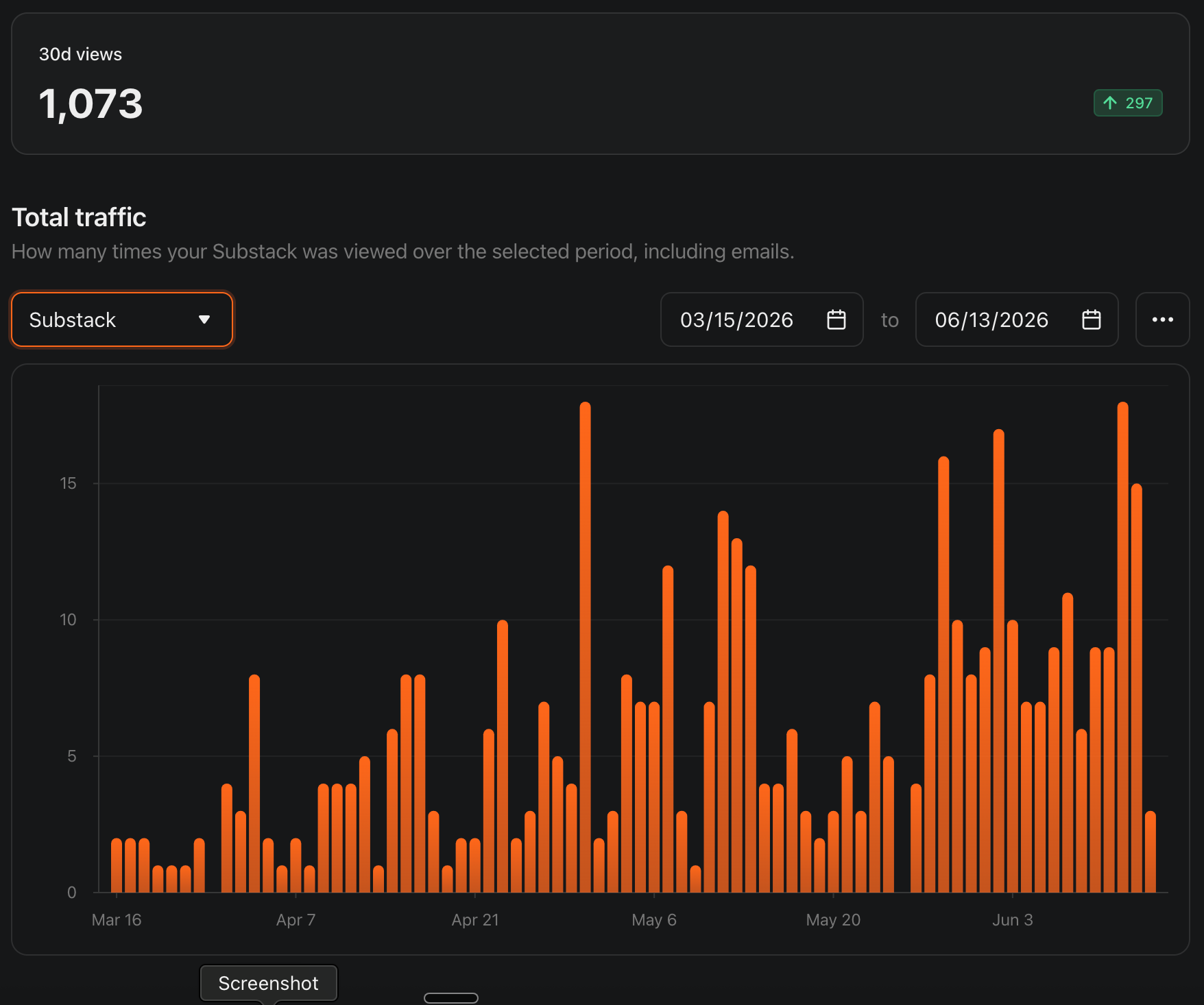
I learned from doing a monthly analytics review. I collected some of my best performing Notes and ask Claude:
💡Here are more Notes that I wrote over the last 30 days. Review and add them to this analysis. I included screenshots of specific Notes that did well and did poorly.
Start writing for the person who most needs to read it.
That person, when they feel found, is also the person most likely to upgrade.
The One Question That Changes Everything
The mechanics are simple. The discipline is harder.
Not every Note needs to end with a question. But at least one per day should invite the conversation. Not “what do you think?” that’s too open, too easy to skip.
A specific question that invites the reader to locate themselves in the problem.
The formula: name the friction point, then ask them to confirm it.
Here are three real Notes I’ve published using this structure:
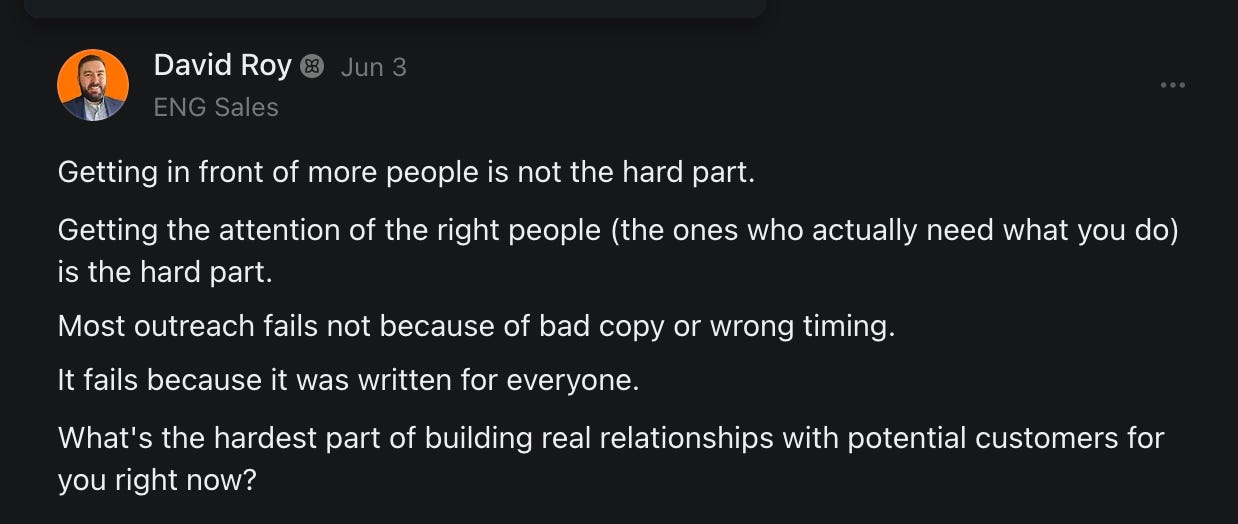
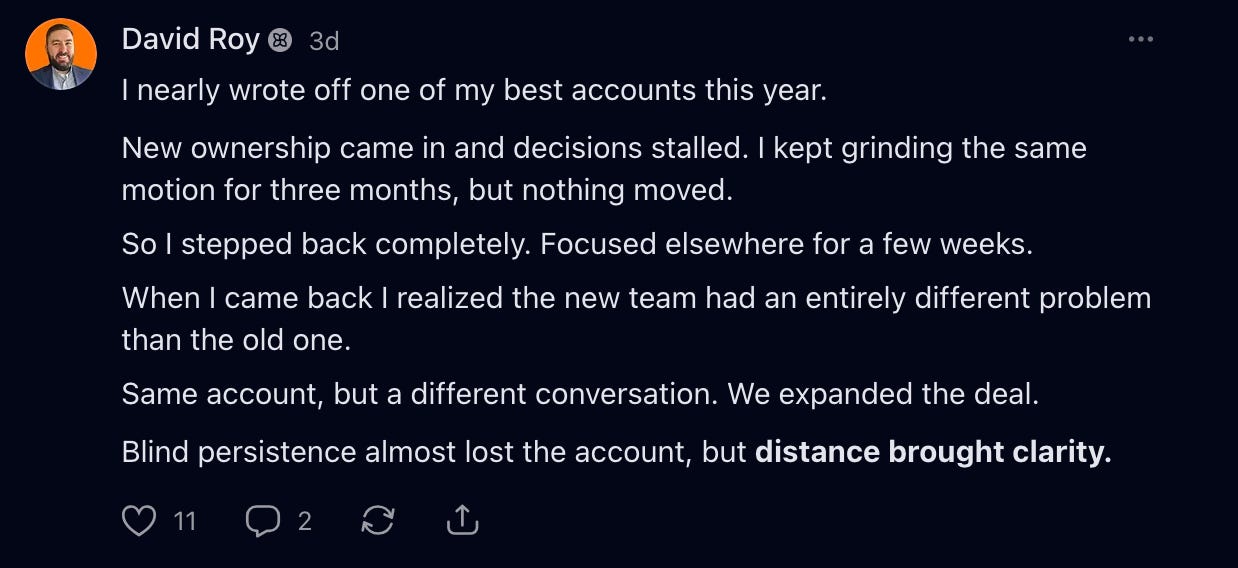
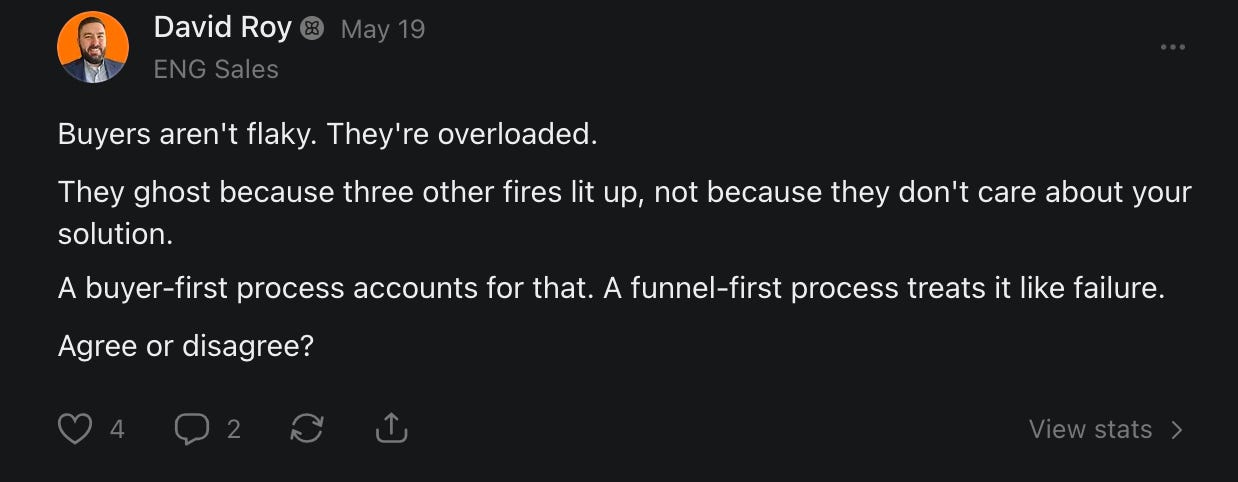
I noticed the pattern drove more comments than I had been seeing before. Each Note names a real friction point first, then invites the reader to confirm whether it’s theirs (some with a question, some with a statement). The invitation to confirm the problem is what separates a declaration from a diagnosis. It shows you understand the struggle, makes replying feel low-effort, and tells you exactly what your audience needs next.
That last part is where the monetization signal lives.
When readers tell you what they’re stuck on, they’re handing you your next ten Notes, your next paid offer, and the exact language your paid tier should use to convert them. You stop guessing what resonates and start building from what they actually said.
One question. Every Note. That’s the whole system.
The Same System. Different Platform.
I help technical founders turn customer relationships into compounding revenue. The system I use is called the Revenue Flywheel three drivers that replace the traditional sales funnel with something that actually builds momentum.
The first driver is Customer Engagement.
It runs on one principle: diagnose first, prescribe second.
The most effective first touch in sales isn’t a pitch. It names a problem the buyer already feels but hasn’t articulated yet. When your opening move shows the buyer you understand their world before you’ve asked them for anything trust starts forming immediately.
That’s exactly what a diagnostic Note does.
When you end a Note with “What’s the one thing that keeps pulling you off your publishing schedule?” you’re not asking for engagement. You’re showing your reader that you already know what they’re struggling with. The question confirms it and invites them into the conversation.
That confirmation is the moment trust starts.
In sales, a buyer who feels understood moves toward a proposal. On Substack, a reader who feels found moves toward paid.
The platform may be different, but the pattern is identical.
The loop tightens with every exchange: a diagnostic question generates a reply, that reply tells you exactly what to write next, your next Note feels even more specific, and trust compounds until the paid conversion happens naturally.
That’s a compounding engagement system.
The creators building real paid momentum on Substack aren’t just publishing more. They’re running the same engagement loop that the best sales teams run: diagnose the problem, show you understand it, earn the right to prescribe the next step.
Your Notes are the first touch. Make them feel like a diagnosis not a broadcast.
Take Action
Don’t wait for your next publish date. Pull up your last three Notes today.
Rewrite the final line of each one as a diagnostic question specific friction point, direct ask.
Publish one every other day this week.When a reply opens a real conversation, follow it. Ask one more question.
That conversation is where your next paid subscriber is.
In that reply you asked them to send.
I write Eng Sales — a weekly newsletter for technical (non-sales) founders who became their own first sales rep by default. Applying the Revenue Flywheel System to daily challenges going sales.
If you want to know where your biggest gap is right now, take the Revenue Flywheel Assessment. It’ll show you which driver is leaking momentum.
👉 Start a discussion in the Unplugged community! Get help or simply introduce yourself and connect with like-minded members, and create meaningful connections.
Kickstart Your Substack Growth:
Get a FREE 10-Day Substack crash course to grow your first 1000 subscribers
Join my FREE Masterclass on how to start making consistent $5,000/month
Join the One and Only Substack Quest to build a high-converting Substack
Work with me to get your Substack up and growing
Save Tons of Time! Use My Custom GPTs & Claude Skills:
The Title Generator that gives me headlines that stop the scroll
The Notes Writer Claude skill that writes Viral Notes, bringing me and my paid members hundreds of subs
The Writer Pro that turns my Notes into >90% human drafts (here’s the free version).
Or get the bundle with all the tools, now at a very special price ;)
Become an Affiliate:
Earn 30% from each sale. Apply below, I approve everyone.
Apply here for my AI tools & templates
Apply here for the SUBSTACK QUEST courses
Become a sponsor:
Reach thousands of engaged buyers.
More from me:
FREE Daily BiTES: A daily mail with just 3 bullets from the most helpful things I read about writing and making money online with AI
Unplugged: The place to be if you want to grow an AI-powered paid newsletter and create content that sells itself.

I am going to apply some of this to my own posts.
Really great stuff.
Here's the best part... "a Note that doesn’t start a conversation can’t start a conversion."
Love it! I think I'm going to restack this right now and quote you on it. Thanks for you're great article Yana!
Best,
Paul Arino