


I had a coaching call with a sales person two days ago.
I help them with their 9-5 job.
They’re doing great with sales, but not growing in the company.
They seemed to know what they want and how to get it, but somehow they don’t get it. So they hired me to help.
Somewhere on the 4th meeting, our conversation revealed something I didn’t expect.
They wanted to get a share in the company. They were promised this share years ago, but they’re not getting it. Common problem, I know.
What surprised me is that they never asked for it.
Why?
Because they believed they’ll be rewarded for their efforts so they don’t have to ask.
Can you imagine?!
I immediately said, you have to ask to get the things you want.
The baby gets fed when it starts crying, not before. No one will think about you and your needs, people think about their own problems most of the time.
Your boss won’t reward you with a bonus or company share just because you’re doing great, that’s what you get a salary for.
My words made this person pause. Think and see things differently.
I could literally feel his brain rewiring in front of my eyes as we spoke.
It’s the same with online business.
Most people don’t make money because they don’t ask for it. They keep burning themselves out with more writing, more content, more engagement. Meanwhile no one knows about their offers.
You have to ask.
How do you think I got almost 1000 paid subscribers and scaled from $5k/month to a $20k/month consistent revenue in less than two years? Here’s proof:
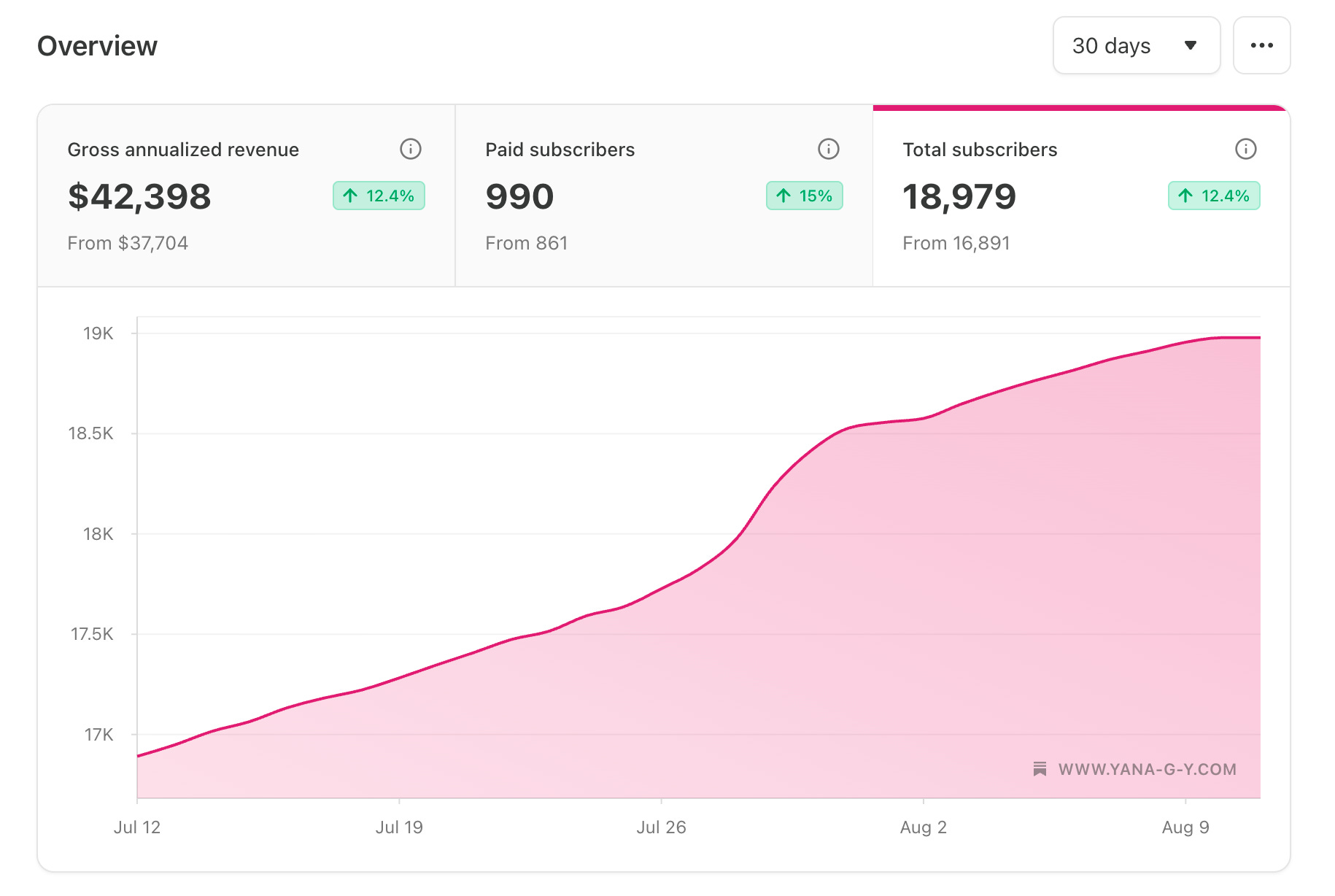
So now you might be thinking, ok, Yana, I’ll ask….
But then you ask, and nobody buys
You write that email. You add that link. You hit that send button.
And then….silence.
Or worse - the replies come in and they all say a version of the same thing. I don’t have the money right now. I don’t have the time. It’s not the right time for me.
So you do the thing everyone does.
You drop the price.
And…..silence. This time louder.
The price was never the problem.
I’ve seen this in my own numbers and in the numbers of the writers I work with, and dropping a price to fix an offer moves almost nothing except your revenue per buyer.
And your confidence in what you do.
I won’t stop repeating this: People love buying, they just hate being sold to.
Every person who lands on your offer page already wants something, or they wouldn’t be there. You don’t enter the negotiation room if you don’t want the deal.
They have their attention on you. What stops them is never the words they said to you - that’s just the official excuse.
Only two real reasons
Yes, there are just two real reasons why people don’t buy, and they’re both rooted in human psychology.
It’s either a trust problem or a limiting belief.
They might look identical at first sight.
They might create the same “official” excuses.
But they need completely different responses, so if you guess wrong, everything you write next makes it worse.
If it’s a trust problem, no amount of objection handling will save you. You can write the best reassurance of your life and it will bounce back at you like a boomerang.
The person doesn’t believe you. But if they’re still here? Think a free subscriber who checked your paid tier and didn’t upgrade.
You have to go back and fix the foundation: add some proof, show some vulnerability, build the connection you probably skipped.
How? You just optimize your Substack for conversion. It’s what I do in my personalized reviews for my VIP members.
But if it is a limiting belief? The person already trusts you.
They read your posts. They open your emails. They might have been on your free list for eight months. They like you.
They just don’t believe the thing you’re selling applies to them.
And that one you can fix. With words. On every touch point of your Substack subscriber journey.
There are only three of types of limiting beliefs
I can list you fifty objections that come to my mind. I’ve heard all of them, and I’ve said most of them myself before I started selling.
And most gurus will match them to another fifty limiting beliefs that stand behind them. And most probably they’re right.
But every single one of those fifty boils down to just three. It’s human nature. I know it from my NLP coach, I’ve proven it with my team in my 9-5, and I’ve tested it in sales negotiations in my job and also in my online business.
Dealing with those beliefs let me grow in my 9-5 to the director level. It made me comfortable to ask, so I negotiated better than average conditions, some say they’re exceptional. It helped me grow my online business to 6 figures, all on the side of my job.
They are just three. Those three:
“It’s not possible.” They don’t believe the outcome is real.
“It’s not possible for me.” They believe it’s real, for the special ones.
“It’s not worth it.” Time, money, or effort. They think the cost is too much.
Those are the three major roadblocks of the transformation. Buying is the beginning of the transformation you’re trying to lead the person to. It’s a change and change is scary, so the human brain finds reasons to resist.
Powerful reasons.
But when you know them? You can beat them.
And that’s valid for anything in life, but let’s stay on topic.
For Substack specifically: you don’t get to have a conversation, you’re not in a boardroom. There’s no sales call. Most people don’t reply to tell you why they don’t buy, even if you ask them.
So you have to handle these beliefs before they ever show up. On every step of your buyer journey. In advance.
Here’s how.
Note: everything below applies only if you have a strong paid offer. If you’re not sure, take the Substack QUEST and build one.
I created a simple cheat sheet you can follow with the methods from this post, download it here (part of the Unplugged Toolbox, coming very soon):
First: find out which belief you’re dealing with
Ask them before you rewrite anything.
Question 1: Has this reader seen proof someone like them achieved what I promise?
Drop all proof that you’re awesome. Add proof that the outcome happened to a normal person (can be you), with a timeframe, and a name they look up and DM.
Be real - if it took 6 or 12 months, say so, don’t sugarcoat.
If you don’t have such proof yet, you can keep the awesomness, just know it’s weak.
You have to change it the moment you get some proof.
If you don’t have anything, it’s a trust problem. Solve it first.
Question 2: Would they take this offer if it was free?
If yes, it’s belief 3.
If they’d still hesitate at free, it’s belief 1 or 2, and price was never in the room.
So how to deal with them?
