


I was digging through my Notes analytics, trying to answer one simple question: where do my paid subscribers come from?
And one thing got my attention.
The profile.
Not the Notes. Not the homepage. But the profile.
From my latest analysis, your profile is the highest converter on Substack.
Why?
Because when a Note gets seen by strangers, it drives profile visits, and the profile is where people decide whether to hit subscribe or move on.
So I did what I always do. I grabbed my phone, opened the Substack app and walked the same path a stranger would walk (you know, I’m obsessed with user journeys).
And that’s when I noticed something I had never paid attention to before.
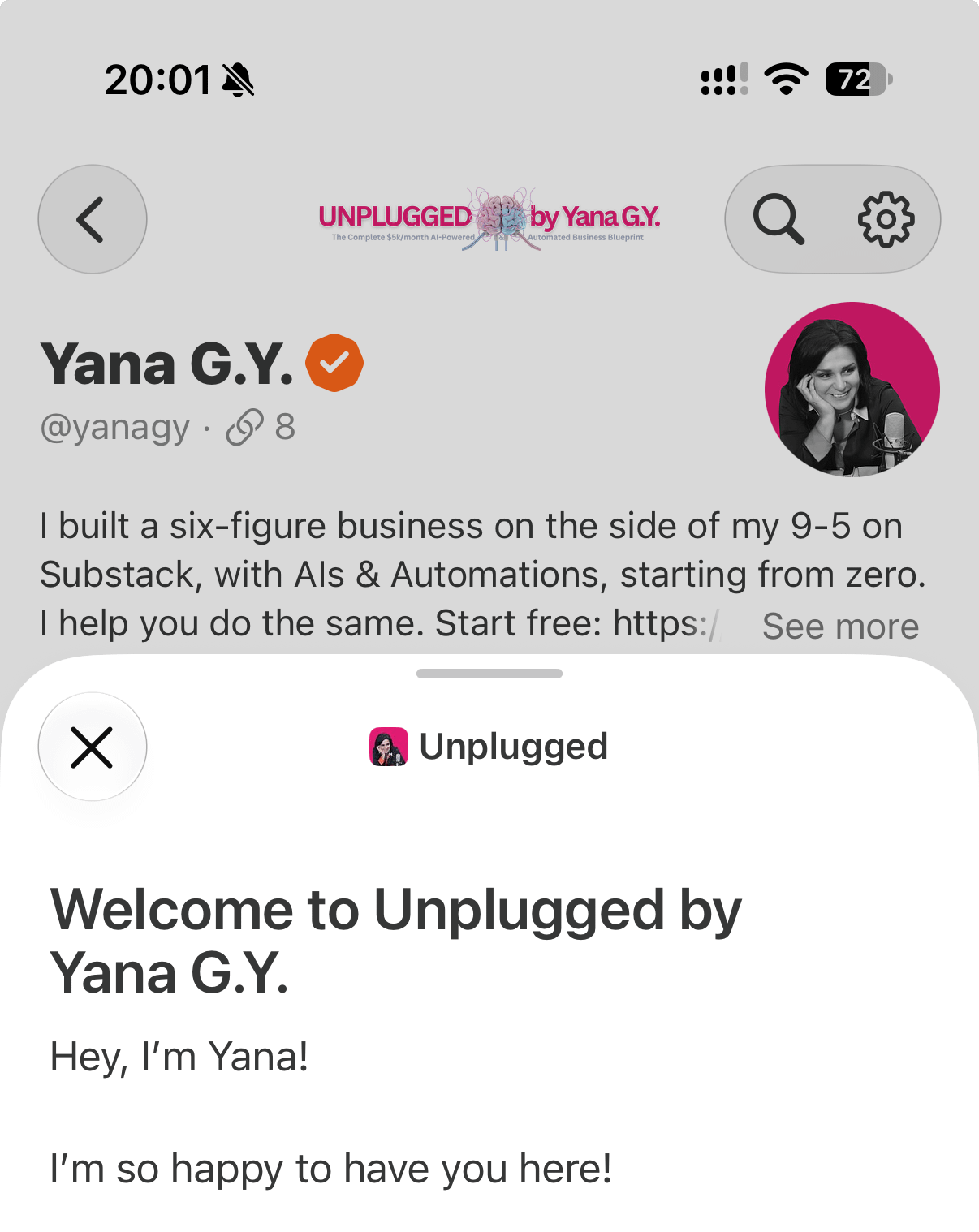
When you open someone’s profile in the mobile app, their wordmark is now right at the top. That’s the publication name or the visual you set in Settings → Website → Header.
And do you know what happens when you tap it?
It opens the About page 👀
Not the homepage. Not the pinned post. But the About page.
So now every single Note you publish is exactly two taps away from your About page.
Note → profile → wordmark → About.
And the app doesn’t even show your navigation bar, so on mobile your About page carries the weight your whole website design carries on the desktop.
Here’s how it looks like:
According to Similar Web, more than 65% of the traffic happens on mobile now.
So think about what most About pages read like.
A third-person bio. “Jane is a writer and coach who lives in Portland with her two cats.” Written once, two years ago, never touched again.”
That’s a CV. And a CV doesn’t convert. Why?
Because of this.
A bio can’t close a warm reader
Not a stranger into a free subscriber.
Also not a free subscriber into a buyer.
The About page is the page people usually check before subscribing, not the bio. The reader who lands there has already read your Note, already tapped your name, already tapped once more to learn about you.
They are actively asking: who are you, and what do I get here?
And what’s in it for me, and mostly why should I pay you?
And you answer with a CV.
There’s one more reason this page can’t wait.
From my data, 76% of my paid members upgrade within their first month.
The decision window is short.
If the page they read doesn’t sell, you’re losing that window.
It’s THAT simple.
And maybe painful.
So.
What’s on the About page that sells for you
Let’s go back to the journey.
A reader discovers you through one Note.
Taps through to your About page.
And instead of a bio, they find a page that tells them what this newsletter is about, what they get as a paid member, proof that it works, and one clear next step after they upgrade.
You don’t need to send an email. Or run a promotion. You just write a Note, and the page does the rest.
That’s not a theory. That’s how any sales page works. Mine including.
You can find more about how to write your sales pages here:

The proof
Now, I can’t check any stats for the About Page, but my “Start Here” page, which is identical, has an impressive conversion rate:
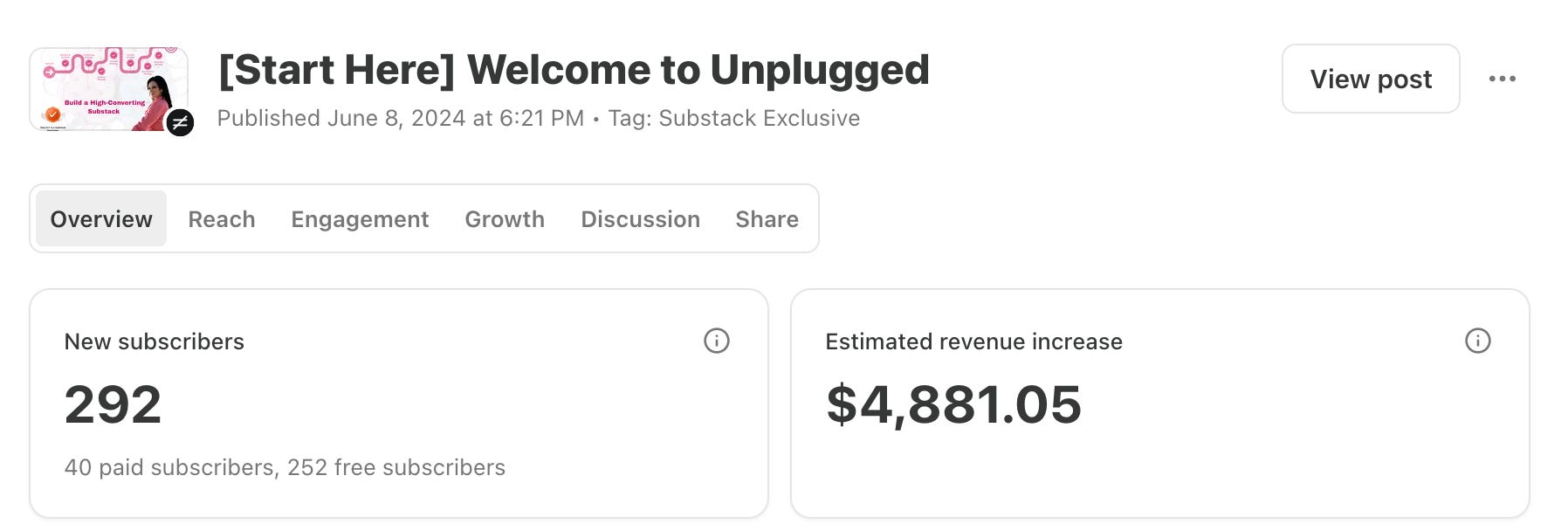
Look at this: 40 paid members from 292 total subscribers gained - that is 13.7%!
It’s way above the industry (and Substack) average.
The industry average free-to-paid conversion is about 3%, and on Substack you can grow it to about 5%, but experts say it’s actually 3%.
By the way I’m curious:
Mine is about more than double that - about 6.5%, and this page structure is one of the main reasons.

It took me an embarrassingly long time to recognize it as a template at all.
I must have edited it about 50 times (if not 100).
I thought I was just writing the way that felt right. But when I analyzed my page and my funnel with AI, there was a pattern.
Six elements. In a specific order. Each one doing one job.
So today I’m giving you:
the exact structure that converts
a checklist you can print and easily follow (if you don’t use AI)
an AI skill you can use to draft yours in the same structure (works for Claude, Gemini & ChatGPT)
Plus the exact wording moves, the image rules, the one Substack trick that makes this page pinnable, and the mistakes that quietly kill conversion.
Ok so now you got everything - my skill, my cheat sheet, my checklist, the entire structure and why it works.
Now go implement and let me know how it works for you.
Bottom line
Look. Your About page is the page people check before subscribing, and it sits one wordmark tap from every Note you publish.
The only question is whether that page is a bio or a sales page.
There are no growth hacks here. You write the page once, properly, and it sells for you every single day after that.
Make it count.
Yana
P.S. If you want the full sales method I use to make my offers sell themselves, including the About page, here it is:
FAQ
What should a Substack About page include? Six elements, in this order: what your newsletter is about, why readers should become paid subscribers (with what free subscribers miss and an upgrade CTA), what you deliver and how (frequency, pillars, formats), a short bold story about you with your picture, testimonials and proof, and links to your socials and website.
Does the About page convert readers into paid subscribers? Yes. The profile is the highest converter on Substack, and the About page is one tap from it. My own About structure, mirrored in my pinned Start Here post, brings me paid subscribers every month. The upgrades happen right after the “what free subscribers miss” section.
How do people find my About page on Substack? On desktop, through your navigation bar or when they add /about after your web address. In the mobile app, they tap your wordmark at the top of your profile and it opens the About page directly. The app doesn’t show your navigation bar, which makes this page even more important on mobile.
Should I write my About page in first or third person? First person, always. “I help you…” builds a direct, personal connection; third person reads like a press release.
Should I put my subscription prices on my About page? Not really. Prices change and promotions run, and an outdated number breaks trust. Link to your subscribe page and let it carry the pricing.
What’s the difference between an About page and a Start Here post? Ideally, your About page is where you talk about your Substack and the Start Here page is where you guide your new subscribers how to navigate your publication. Mine hold the same content, but yours don't need to. The About page can’t be pinned, doesn’t support personalization and also doesn’t allow comments, so I keep a Start Here post that mirrors it, pin it, and add it to my navigation.
I’m Yana, a Substack Bestseller and growth coach. I built 21,000+ subscribers newsletter with 1,400+ paid on the side of my corporate job, with a free-to-paid conversion rate more than double the Substack average, and I help you with the exact system inside the SUBSTACK QUEST.
Sound advice! Thanks for sharing 🙏