


Ellen Scherr had never written a word online and said she hated writing but her mental health Substack grew from 245 to 22,291 subscribers. We started working in June 2025, building Substack from scratch. In January 2026, it generated $6,079 in revenue. This is the full story of what we built together and how my Substack QUEST monetization model works.
“I hate writing.”
That’s the first thing she told me.
“I’m nervous about it” would have been fair. “I’m not sure I’m good at it” would have made sense. But Ellen had never written a single piece online and she was honest about it.
What she had was a thriving private therapy practice. Clients she had worked with for years. A deep, research and science backed approach and a license to help people. And a problem: trading hours for dollars has a ceiling, and she had hit it.
She wanted to build something that could grow without her booking every hour. Something that could keep going while she slept. Something that did not require her to show up for every single person individually.
She wanted Substack.
And honestly, when she told me she hated writing, my first thought was not doubt. It was relief. That meant she would not have any bad habits to unlearn.
We started working together in June 2025.
What we were working against
Mental health is a brutal niche - on Substack and on the Internet in general.
There is a massive audience for it. And there’s a flood of content. The problem is the writers. Almost everyone in the space is scared. Scared to write with any edge. Scared to have opinions. Scared their licensing board is watching. Scared to say anything that could be misconstrued as advice. Scared to be bold.
The result? Most mental health content sounds exactly the same. Safe. Warm. Beige. Honestly - plain boring. “Here are 5 ways to manage stress.” “Breathe deeply.” “It’s okay not to be okay.”
Ellen is a licensed therapist with 20+ years of experience. She could write circles around most people on the clinical stuff. But clinical was boring too.
The play was what she actually lived and believed. The story of her divorce. What she had seen in her practice. What she thought the mental health world got wrong, what it got right, and what it completely missed.
The play was her.
So that is what we built.
The grind phase (yes, there’s always one)
Ellen posted consistently for months. She hated it but she had to do it.
Good posts. Thoughtful posts. Posts that took real work to write.
And she got to around 200 subscribers.
I’ll be honest about this because a lot of people show you the hockey stick and skip the flat line before it. The flat line is real. It happens to everyone. It is not a sign your strategy is wrong. It’s just a phase you have to push through.
Ellen kept showing up even when it felt like writing into a void. She kept learning how to write for the format. She kept improving. She kept implementing everything we worked on.
Then on November 13, 2025, she published this:

The subtitle: “Your brain’s middle finger to people-pleasing.”
It went viral. On the Internet, not only on Substack - got shared to social media and on other sites.
By the end of the month, the post had tens of thousands of likes, thousands of restacks, and Oprah Daily picked it up.
Oprah Daily.
From a therapist who said she hated writing six months earlier.
What the numbers look like now
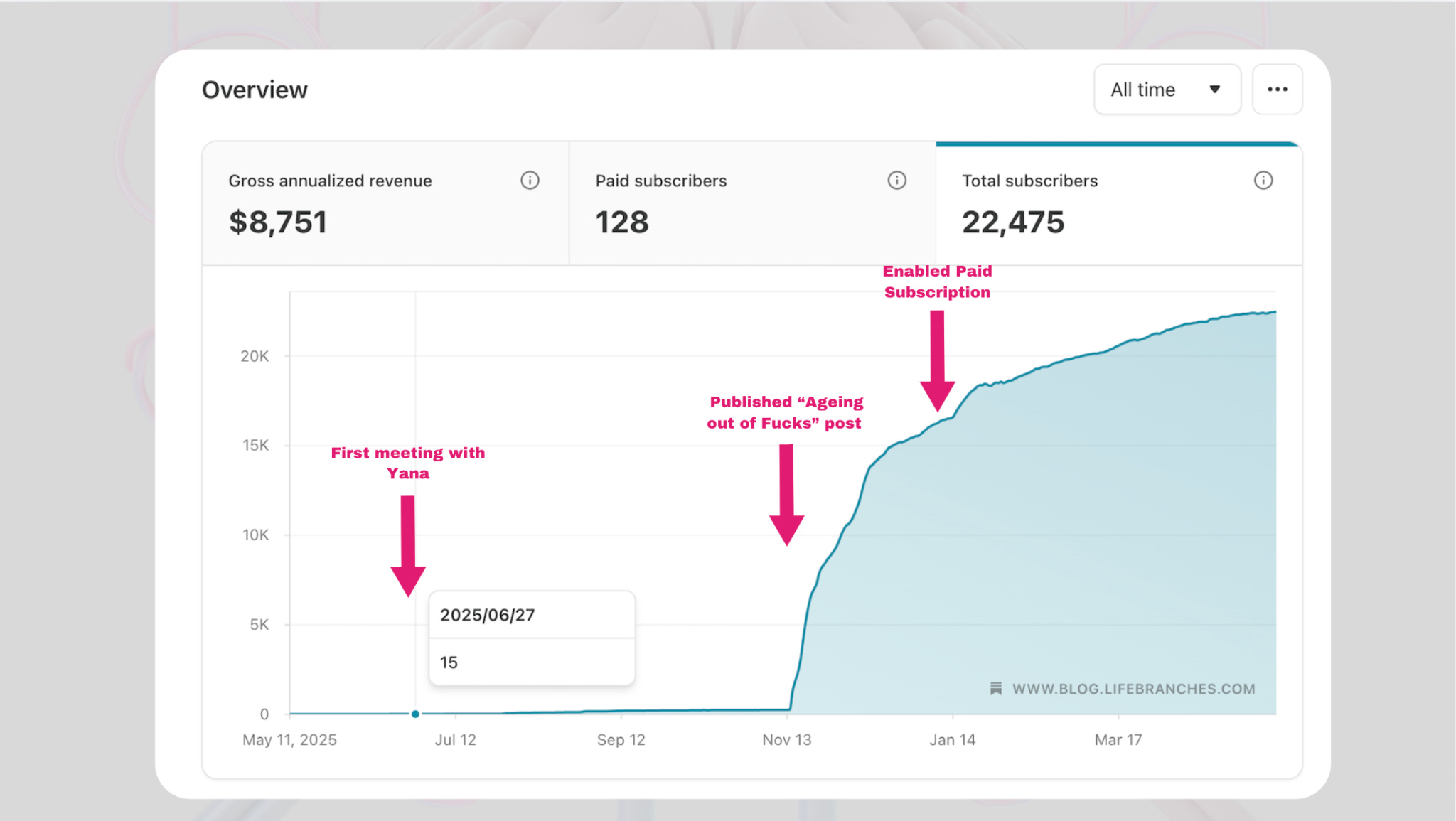
22,475 subscribers.
In the mental health niche. With a founder who had never written online before and hated writing.
But here is the number that matters most to me, because it is not just a subscriber count. It is a business.
In January 2026, Ellen’s Substack generated $6,079 in revenue.
It’s when she enabled her paid subscription (finally), but that revenue came from three sources compounding together: paid memberships, digital products, and 1:1 therapy work booked directly through her Substack funnel.
That’s the model. The therapy work stays. We made it the premium tier of a layered offer stack, where the Substack handles the relationship-building and the trust. The funnel goes to Kit.
Today, almost every post she publishes gets 100+ likes. Almost every Note she writes goes viral. Her audience does more than read her. They share her.
What actually made this work
This is not a story about one viral post.
The viral post only amplified what was already there - the conversion engine.
By the time that post hit, Ellen had a Substack ready for the traffic. A proper welcome sequence. A clear offer stack. And a clear idea for a paid subscription that was worth upgrading to.
A positioning that made her instantly distinct in a sea of beige mental health content.
Without that infrastructure in place, viral traffic bounces. You get a spike on your analytics dashboard, and then everyone leaves because there is nothing there to hold them.
The post went viral because Ellen finally wrote something unapologetically hers. The subscribers stayed and converted because of what we had built underneath it.
Here is what we built. And how you can apply the same framework to your own niche.
The model, piece by piece
Ellen’s results came from five components of the QUEST framework working together. Remove any one of them and the outcome is different. Here is what each one looks like in practice.
#1 Positioning: stop being a therapist, start being a voice
Most mental health creators on Substack position themselves as therapists. Which means they write like therapists. Cautious. Neutral. Careful. And honestly? Boring…
Ellen is a licensed mental health therapist. But that is not her positioning.
Her positioning is the person who tells you the uncomfortable neurological truth about why you are the way you are, without judgment, without jargon, without making you feel broken.
That is a completely different thing.
We built this by going through what she actually believed, and lived - her divorce. The stuff most people in her field would not say out loud. And she wouldn’t too in the beginning.
I remember she told me “I haven’t got a good story to tell, it’s all boring”. Turns out she did have one - and it surfaced very clearly during the positioning work. It was her first post:
It got more than 200 likes and a lot of heated comments. That’s when we knew we’re on to something.
The things she told clients in session that made them go quiet and then say, “I’ve never heard anyone explain it that way.”
That is your positioning. Your edge.
Your credentials are context. Your modality is method. Your edge is what makes the writing yours.
For Ellen, the edge was: “your brain is not broken, your circumstances trained it, and here is the science that proves it.”
That exploded.
Once we had that, every piece of content had a clear filter. Does this sound like Ellen, or does it sound like a textbook?
#2 The setup: funnel first, content second
Most people build a Substack like this: write posts, hope people subscribe, figure out the rest later.
That is backwards.
Before Ellen published her tenth post, we had built the full infrastructure:
A Welcome email that established her voice and set clear expectations
A Start Here page that told new subscribers exactly what Life Branches was about and who it was for
An About page with real social proof: her clinical background, her philosophy, her actual opinions
A simple offer stack made of a freebie, a low-tier ebook, a mid-tier product and a high-tier therapy offer
A funnel in Kit designed to monetize at a high conversion rate
And content engine designed to bring in new subscribers
When I checked her analytics the week after the viral post hit, the email open rates were above 50%. Usually it’s normal if you have 10-ish new subscribers per day, but she had 100+.
That told me everything.
The model did its job. New subscribers were not bouncing. They were landing in a funnel that was ready for them.
If your Welcome email says “thanks for subscribing, I’ll be in touch,” you are wasting the warmest moment in the relationship. That is the moment a new subscriber is most likely to engage, upgrade, and stay.
Simple rule: treat your Substack like a product, not a blog. In my model, every touchpoint is designed to convert. Every page, every post, every Note has a job.
Optimize for a high conversion rate: that is my superpower. That’s what I help people build.
#3 The growth engine that compounds
One viral post means nothing if you can’t replicate it.
And Ellen did, multiple times. That’s what kept her growing, long after the virality happened.
How?
She listened to the data signals and double downed on what worked. No matter how uncomfortable it was. She did the work that needed to be done.
A “fuck” in the headline? Check.
A vulnerable story about a painful divorce? Check.
Controversial Notes that challenge common beliefs? Check.
You can have a viral moment and then stagnate. Or you can have a viral moment and build a compounding engine. The difference is whether you treat your content as an afterthought or as a core part of your strategy.
Because when you do, you don’t need virality. Your content will convert.
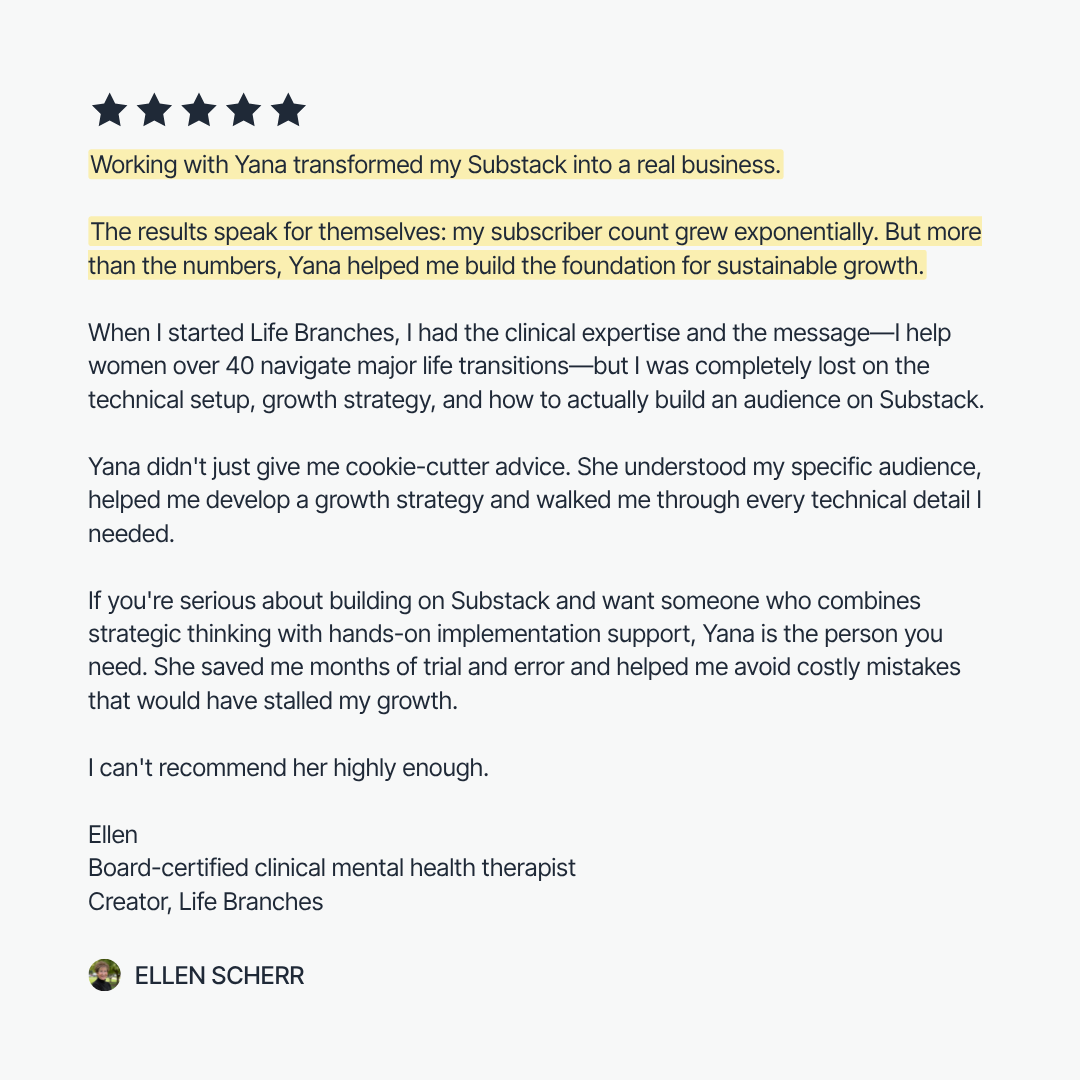
Here’s what Ellen said about working with me:
The thing nobody wants to hear
Ellen implemented all of it.
She rewrote her About page multiple times. She built I don’t know how many Welcome emails when most people have zero. She wrote Notes and posts consistently even when they did not go anywhere. She kept publishing for months at 200 subscribers, when the easier thing would have been to decide it was not working.
Did she make it because of working with me? No. I only showed her the fastest route.
Did she make it because of a viral post? No. It only amplified what she already had in place.
She made it because she knew the work has to be done. And she did it. On time. And she’s still doing it.
Even at 71 years of age. Even when she was moving between states. Even after she had a painful surgery. Even when she felt exhausted from another meeting with a client.
Everyone has excuses. Few people have the grit to work through them and actually make things happen. Even after it starts growing.
Because growth is also a trap.
Many people decide to take a rest when it finally worked. But that’s exactly the moment when they turned their growth to decline.
My QUEST framework works.
I’ve extracted it from 20+ years of building and selling products on subscription in one of the largest telco groups in the world.
I applied it on my Substack and it worked.
I helped Ellen apply it and it worked.
I’ve seen many of my paid members apply it and grow, some even beyond my size.
I’ve seen it work across multiple niches: AI, product development, finance, data science, leadership, marketing, mental health, food, medicine, podcasts, even physical products. The pattern holds.
Because I developed it from a real business, that makes billions of dollars, not just my trial and error or experiments online.
But it only works for people who implement it. Who iterate when something does not land. Who keep going past the point where most people stop.
Ellen is one of those people.
Building a real Substack business is heavy work. The people who stick with it are the ones who stop looking for the light version.
Ellen still says she hates writing sometimes. But in January 2026, her words generated $6,079. That is what happens when the strategy is right and the person doing it does not quit.
Yana
P.S. If you think you have the balls to do what Ellen did, this is where it all started.